
TL;DR — Why This Matters
Ladder-related accidents aren’t just dangerous—they’re financially catastrophic. The average cost of a single ladder fall in construction is about $27,000, and serious cases can exceed $100,000 once medical bills, insurance hikes, and legal fees are includedLadder Safety_ Costs, Citations…. OSHA data show 27,000+ nonfatal ladder injuries and 800+ deaths in just five years, with fines reaching up to $165,514 per violation for repeat offendersLadder Safety_ Costs, Citations….
In Ohio, accepting an OSHA citation can even increase workers’ compensation payouts by 15–50%, multiplying the long-term liabilityLadder Safety_ Costs, Citations…. But there’s a better way: replacing ladder inspections with FAA Part 107 drone operations not only eliminates the physical risk—it reduces insurance premiums, workers’ comp rates, and exposure to litigation.
For property owners, insurers, and safety managers, this document shows the hard financial evidence that “No Ladder. No Liability.” isn’t marketing—it’s math.
Ladder-fall costs: Falls from ladders carry steep direct costs. Industry data show the average cost of a single construction injury is about $27,000friedmansanchez.com. (For context, NSC notes the overall average fall-related workers’ comp claim is ~$48,500blog.zeitview.com.) These costs include medical bills, lost wages, rehab and legal expenses. Ladder falls are common: OSHA data count 27,000+ nonfatal ladder injuries (with days away from work) from 2017–2021ndsc.org. The upshot is each ladder accident risks tens of thousands in liability and medical/legal expense.
- Key cost drivers: Serious ladder injuries often require ER/hospital stays. Over 80% of fall-to-ER visits in construction involve laddersfriedmansanchez.com, and ~14% of ladder-injury victims are hospitalizedfriedmansanchez.com. Time off work and reduced future earnings add to the $27K average.friedmansanchez.com
- Aggregate impact: High frequency of ladder falls means millions in annual costs. NSC/OSHA reports over 27K ladder-related injuries (plus 800+ deaths) in a five-year spanndsc.org. These statistics underscore why businesses face large liability for even a single ladder accident.
OSHA Citations & Insurance Premiums
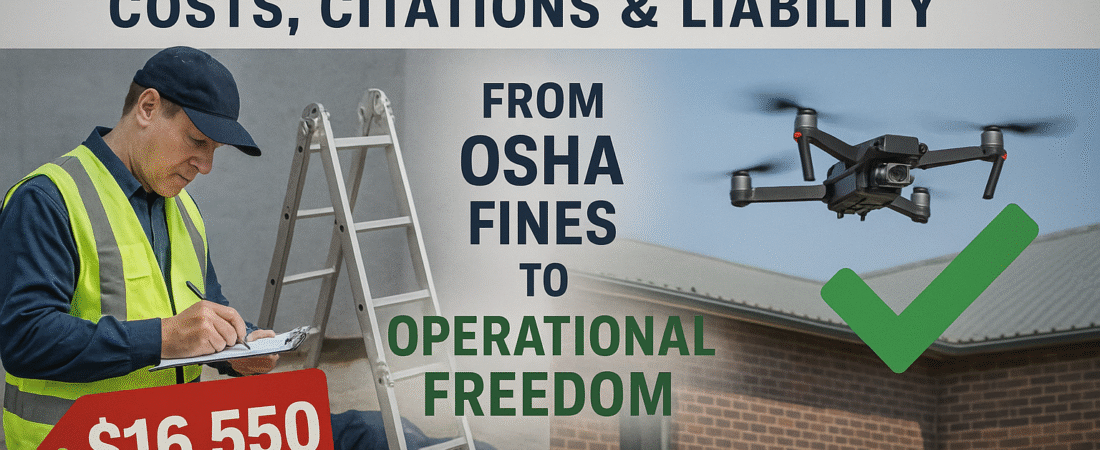
OSHA fines: Violations of ladder/fall-safety rules can trigger hefty citations. Under current rules, serious or other-than-serious violations carry up to about $16,550 per incident; willful or repeated violations can reach $165,514 eachosha.gov. (These 2025-adjusted limits are per OSHA’s penalty scheduleosha.gov.)
- Example: Failing to secure a ladder or provide fall protection could draw a serious-violation penalty (~$16K). A willful disregard (e.g. knowing violation of mandatory fall protection) could cost an order of magnitude more.
Insurance impact: OSHA citations directly raise a company’s insurance costs. Insurers view violations as red flags: one analysis notes a single serious OSHA citation typically increases premiums ~5–15% (depending on size/severity), while a willful violation can spike premiums 20–50% or even trigger non-renewalfederato.ai. Repeated violations compound increases (roughly 15–25% more per repeat)federato.ai.
- Experience Modification (EMR): OSHA injuries and fines tend to worsen a firm’s EMR. For example, a serious fall-violation can raise EMR by ~0.05–0.10, and a fatal-violation by ~0.20+, markedly hiking workers’ comp premiumsfederato.ai.
- Hidden costs: A single $16,550 fine often signals a serious injury. When that happens, legal fees, defense costs and claim payouts can push total cost well beyond six figuresfederato.ai. (One scenario found a $16.5K OSHA penalty linked to over $100K total lossfederato.ai.)
Ohio specifics: Ohio law adds further exposure. If an Ohio employer accepts an OSHA citation, state rules allow 15–50% higher workers’ comp benefit payouts for the injuryohiocompensationlawyer.com. In effect, an OSHA fine not only brings a direct penalty, it can increase the employer’s future WC costs by up to half againohiocompensationlawyer.com. (Courts in Ohio apply this even for non-willful violations, meaning any OSHA citation can hike payoutsohiocompensationlawyer.com.)
Ohio Case Law: Property Owners & Ladder Falls
Several Ohio cases illustrate the risks for property owners when contractors fall from ladders:
- Patterson v. Adleta, Inc. (Ohio 1st Dist. 2018): A fuel-delivery worker fell from a ladder on a customer’s property. The court held ladder-climbing is “inherently dangerous,” so the landowner owed no duty of carereminger.com. Because the hazard was open-and-obvious (the worker placed the ladder himself), the “active participation” exception did not apply. The appeals court granted the owner summary judgment, finding no negligence exposure for the landownerreminger.com.
- Cracraft v. Dayton Power & Light Co. (Ohio 2d Dist. 2016): An independent contractor slipped from a roof ladder. The court affirmed summary judgment for the utility. It cited long-standing Ohio law: owners owe no duty to contractors performing inherently dangerous work unless the owner actively participates or controls a critical safety elementreminger.comreminger.com. Here, DP&L simply provided site access and did not control the ladder setup, so no duty existed and the claim failedreminger.comreminger.com.
- Hackney v. Ward (Ohio 2d Dist. 2014): A homeowner loaned a ladder to a roof inspector (independent contractor) who later fell. The court granted judgment to the homeowner. It found the homeowner’s role was limited to providing and positioning the ladder; he did not direct the work or exercise control over a critical actlaw.justia.com. Under Ohio’s “active participation” test, those few acts did not establish liability. The inspector could not show how the homeowner’s actions breached a duty or caused the falllaw.justia.com.
These cases consistently show that, in Ohio, a property owner is generally not liable for a contractor’s ladder fall unless the owner actively intervened in a dangerous way. Landlords and clients should note: keeping defensive training and equipment up to code is crucial, but mere possession of the premises or tools usually won’t make them legally responsible for a contractor’s accidentreminger.comreminger.com.
Drones: Liability Reduction and Insurance Benefits
Using drones for inspections can reduce ladder-related liabilities and even lower insurance costs. By keeping inspectors on the ground, drones virtually eliminate the risk of falls from ladders or roofs. In turn:
- Fewer claims: With drones, the principal risk (falls) is removed, so workers’ comp and liability claims for fall injuries drop dramatically. NSC data show falls have the highest median claim cost (about $48,575 per claim)blog.zeitview.com. Avoiding these incidents not only saves this expense, but also prevents associated legal and indirect costs.
- Premium discounts: Some insurers reward the improved safety profile. One drone inspection provider reports clients saving 2–3% on liability premiums after switching to drone roof inspectionsblog.zeitview.com. This reflects the insurer’s view that drone surveys (with accompanying imagery) yield more accurate risk data and fewer claimsblog.zeitview.comblog.zeitview.com.
- Workers’ comp reclassification: For roofers and contractors, drones can change the risk classification. For example, if sales/inspection staff no longer climb on roofs, a company can reclassify those workers from high-risk “roofing” codes to low-risk “sales” codes. In one analysis, this shift reduced workers’ comp premiums by ~99% (e.g. from ~$10K down to ~$170 per $50K payroll)lovelandinnovations.com. (Roofing work carries one of the highest comp rates; reassigning it as “outside sales” dramatically cuts the ratelovelandinnovations.com.) Over time, the very low injury rate also improves the experience modifier.
In sum, adopting drones for inspections can translate to tangible savings. Beyond avoiding ladder falls, companies may earn insurance credits or lower their EMR. Investing in drone programs not only safeguards workers, but can yield measurable reductions in insurance premiums and workers’ comp costsblog.zeitview.comlovelandinnovations.com.
Sources: Industry analyses and case reviews from OSHA, NSC, and legal experts (Friedman & Sanchez LLP) were used. Key figures and rulings are cited abovefriedmansanchez.comosha.govohiocompensationlawyer.comreminger.comlaw.justia.comlovelandinnovations.com. All insurance and penalty figures reflect current 2024–2025 rates unless noted.