TL;DR
Part 107 certification opens the door to commercial UAS work, but real career progression requires specialized payload mastery, strong safety culture, and the ability to deliver measurable client outcomes. The biggest industrial value lies in advanced missions—pipeline and transmission inspections, construction survey work, public-safety support, and precision agriculture. Operators develop niche expertise in LiDAR, photogrammetry, thermal/multispectral imaging, and eventually BVLOS operations, which demand waivers, detect-and-avoid systems, and strong SOPs.
Commercial success hinges on translating this capability into ROI: reduced field risk, lower operational costs, clearer documentation, stronger insurance positions, and tax advantages via Section 179. Professional expectations include asset-specific “before/after” documentation, data-retention security, auditable maintenance logs, and insurance coverage including UASL and E&O. As Part 108 emerges, standardized BVLOS frameworks will unlock large-scale industrial operations.
The Part 107 Remote Pilot Certificate serves as the essential gateway to a rapidly expanding commercial sector, where Unmanned Aircraft Systems (UAS) are fundamentally transforming industrial workflows. For aerial inspection companies, achieving commercial viability requires transcending basic regulatory compliance by adopting a professional mindset focused on advanced training, rigorous data security, and clear articulation of business value.
I. Commercial UAS Use Cases: The Market Landscape
Commercial drone applications span nearly every industry, leveraging speed, accuracy, and safety to replace traditional, slower, and often riskier methods.
A. Infrastructure and Industrial Inspection
Drones are extensively utilized to inspect critical linear assets such as pipelines and transmission lines, as well as complex vertical infrastructure like cell towers and bridges.1 This replaces the highly dangerous practice of manual human inspection, often involving rope access or scaffolding, by sending a UAV into a situation that would be hazardous for a person [22],. The applications include:
- Utility Monitoring: Identifying defects, corrosion, or vegetation encroachment along power lines and rights-of-way.
- Energy Assessment: Inspecting wind turbines, solar farms, and oil and gas infrastructure.
B. Construction, Surveying, and Real Estate
In the construction and geospatial sectors, drones accelerate data acquisition and improve decision-making accuracy:
- Surveying and Mapping: Drones facilitate the creation of detailed topographic maps and aerial surveys, often completing a $12$-acre site inspection in as little as $2$ hours, compared to $100$ hours manually.
- Volumetrics: Accurate measurement of stockpile volumes is essential for inventory management and cost estimation in mining and construction.
- Construction Monitoring: Drones track project milestones, monitor compliance, and provide accurate progress documentation, which minimizes costly rework by identifying potential issues early.
- Real Estate: Beyond marketing, drones are crucial for property assessments and appraisals, providing detailed visual inspections of hard-to-reach areas like rooftops, eliminating the need for expensive or risky equipment.
C. Public Safety and Resource Management
In public safety, drones provide real-time visuals for emergency response and search-and-rescue operations 1,. In environmental management and agriculture, specialized payloads are used for precision data collection (e.g., crop health, forestry surveys).2
II. The Professional Career Path: From Part 107 to Advanced Operations
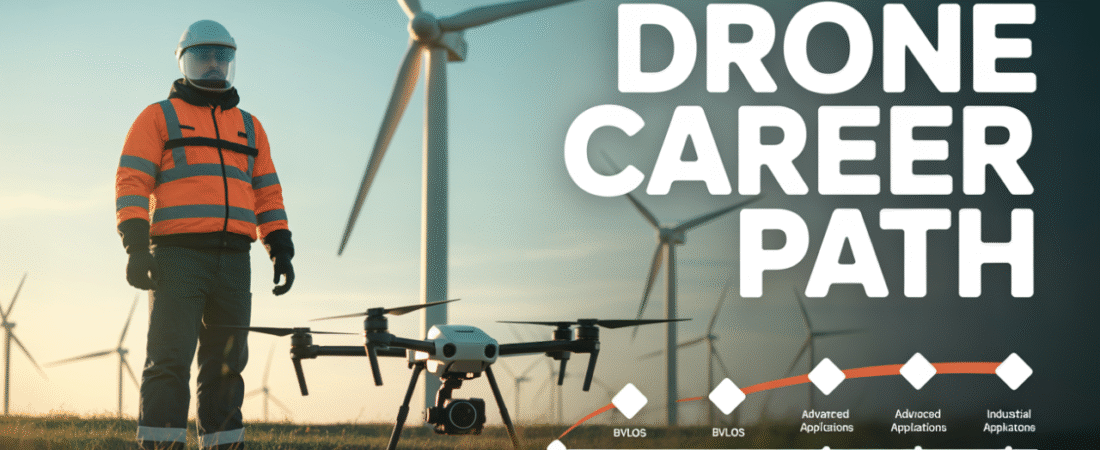
The Part 107 Remote Pilot Certificate is the mandatory foundational license for commercial work.3 Career progression is defined by the mastery of specialized payloads and the ability to secure authorizations for complex operations that deviate from the standard Visual Line of Sight (VLOS) baseline.
A. Specialist Training and Payload Expertise
Moving beyond the basic Part 107 skillset involves acquiring specialized knowledge in core industrial technologies:
- Photogrammetry: Expertise in mission planning and processing software is crucial for converting raw imagery into high-accuracy $3\text{D}$ models and survey-grade deliverables.5
- LiDAR Systems: Training in operating and processing data from expensive, high-accuracy LiDAR sensors is necessary for missions requiring terrain penetration (e.g., through dense vegetation) or centimeter-level volumetric accuracy.6
- Thermal/Multispectral Imaging: Proficiency in utilizing radiometric thermal cameras for quantifiable inspection outputs (e.g., detecting defects in solar panels or insulation failure) is key for condition monitoring and predictive maintenance.
B. Advancing Beyond Visual Line of Sight (BVLOS)
The highest tier of operational competence is the mastery of Beyond Visual Line of Sight (BVLOS) flight, which is essential for scalable industrial missions like long-range pipeline or corridor inspections.2
- Waiver Requirement: BVLOS operations violate the fundamental Part 107 VLOS rule ($\S 107.31$) and therefore require a complex operational waiver.7
- Mitigation Strategy: Obtaining a BVLOS waiver requires the pilot to demonstrate an equivalent level of safety using advanced safety technologies—such as Detect-and-Avoid (DAA) systems—and providing detailed, evidence-based risk mitigation protocols.8
- Future Regulatory Path (Part 108): The proposed Part 108 rule is designed to replace the current fragmented BVLOS waiver system with a standardized, scalable framework for routine autonomous flights, marking the future regulatory pathway for industrial drone applications.2
III. Quantifying Business Value and Return on Investment (ROI)
For an aerial inspection company to succeed, it must translate its technical capabilities (Part 107, BVLOS, LiDAR) into measurable economic and safety advantages for the client.
| Client Benefit | Mechanism of Value Creation | Quantified Impact |
| Safety and Risk Reduction | Eliminates the need for humans to access dangerous areas (e.g., high structures, unstable ground) [22],. | Eliminates worker exposure to high-altitude or hazardous area risks. |
| Operational Cost Savings | Reduces labor hours, minimizes equipment rentals, and completes data collection significantly faster than manual surveys. | Reduces operational costs by $20-35\%$ and up to $30\%$ overall,. |
| Tax Advantages (Section 179) | Enables businesses to deduct the full purchase cost of qualifying UAS equipment, sensors, and software in the year they are placed into service. | Deduction limit of up to $\$1.16$ million in qualifying equipment purchases for the 2024 tax year, providing immediate tax savings,. |
| Insurance/Liability Mitigation | Certified pilots and documented, auditable maintenance logs reduce the probability of equipment failure and accidents.[10] | Leads to more favorable insurance premiums and terms by demonstrating a reduced operational risk profile.[10] |
IV. The Professional Mindset: Standards, Security, and Documentation
The professional mindset is built on a rigorous safety culture, auditable record-keeping, and proactive management of legal and security risks.
A. Professional Standards and Safety Culture
- Standard Operating Procedures (SOPs): SOPs must be developed and strictly followed to standardize workflows, ensure consistent regulatory adherence, and minimize the risk of human error across all missions.11
- Crew Resource Management: The Remote Pilot in Command (RPIC) is fully responsible for the flight.13 If a Visual Observer (VO) is used, the RPIC must ensure continuous, effective communication and coordinate hazard scanning with the VO,.
- Maintenance and Airworthiness: Commercial operators are required to maintain detailed, auditable records of all maintenance and preventative maintenance, including the status of life-limited parts.14 This documentation is mandatory for the FAA Administrator or NTSB upon request.14
B. Documentation and Client Expectations
- “Before” and “After” Documentation: For inspection work, professional protocols require establishing a baseline of the asset’s condition (“before”) and then focusing the bulk of the post-flight work on the review and analysis of the collected visual data (“after”) [22],.
- Insurance and Contracts: Clients often mandate that the UAS operator carries significant Unmanned Aerial System Liability (UASL) coverage (typically $\$1$ million minimum) and often requires the operator to name the client as an “additional insured” on the policy.10
- Protection Against Negligence: For inspection services, Professional Liability Insurance (Errors and Omissions, or E&O) is essential, covering financial losses to the client resulting from alleged negligent service or data errors (e.g., a failure to detect a critical flaw).16
C. Data Security and Regulatory Risk
The professional operator must actively manage risks emanating from federal compliance and technology supply chains:
- Remote ID Security Threat: The FAA’s Remote ID (RID) rule requires the public broadcast of both the drone’s location and the physical location of the control station (operator).18 This public disclosure exposes the operational site, creating a risk of corporate espionage or compromising confidential business information.18
- Manufacturer Risk: Drone manufacturers often retain remote access and super-user privileges for diagnostics and firmware updates, facilitated sometimes via cellular networks.19 This manufacturer privilege creates an additional security vector that must be managed by the commercial operator.
- Data Integrity: SOPs must include procedures for the secure retention of contractually required inspection data while ensuring the timely and secure deletion of any non-essential bulk data collected incidentally during the mission, minimizing legal exposure.20
Works cited
- Drones are soaring, but privacy protections lag behind, says ASU expert, accessed October 31, 2025, https://news.asu.edu/20251028-law-journalism-and-politics-drones-are-soaring-privacy-protections-lag-behind-asu-expert
- Part 108 Explained: The FAA’s New Drone Regulations – Pilot Institute, accessed October 31, 2025, https://pilotinstitute.com/part-108-explained/
- FAA COA vs Part 107 for Public and Commercial Use – ABJ Drone Academy, accessed October 31, 2025, https://abjacademy.global/drone-blog/faa-coa-vs-part-107-for-public-and-commercial-use/
- FAA Part 61 vs. 107: Which Certification Path Should You Follow? – Leopard Aviation, accessed October 31, 2025, https://leopardaviation.com/faa-part-61-vs-107/
- Photogrammetry software: complete guide for accurate 3D mapping and reconstruction – DroneDeploy, accessed October 31, 2025, https://www.dronedeploy.com/blog/photogrammetry-software-complete-guide-for-accurate-3d-mapping-and-reconstruction
- Choosing the Right Drone Based LiDAR System – Measur Drones, accessed October 31, 2025, https://measur.ca/blogs/news/choosing-the-right-drone-based-lidar-system
- Part 107 Waivers | Federal Aviation Administration, accessed October 31, 2025, https://www.faa.gov/uas/commercial_operators/part_107_waivers
- BVLOS & VLOS: A Comprehensive Guide for Drone Pilots, accessed October 31, 2025, https://www.dronepilotgroundschool.com/bvlos-vlos/
- FAA’s proposed Part 108 BVLOS Rule: Industry response and key concerns | DLA Piper, accessed October 31, 2025, https://www.dlapiper.com/en-eu/insights/publications/2025/10/faa-proposed-part-108-bvlos-rule
- Drone Insurance Guide 2025: Costs, Coverage & Best Providers – JOUAV, accessed October 31, 2025, https://www.jouav.com/blog/drone-insurance.html
- UAS STANDARD OPERATING PROCEDURES – Connect NCDOT, accessed October 31, 2025, https://connect.ncdot.gov/resources/Aviation%20Resources%20Documents/NCDOT_UAS_SOP.pdf
- accessed October 31, 2025, https://www.flyeye.io/drone-acronym-sop/#:~:text=Drone%20pilots%2C%20organizations%2C%20and%20regulatory,calibration%2C%20and%20emergency%20contingency%20plans.
- Become a Certificated Remote Pilot | Federal Aviation Administration, accessed October 31, 2025, https://www.faa.gov/uas/commercial_operators/become_a_drone_pilot
- 14 CFR Part 107 — Small Unmanned Aircraft Systems (FAR … – eCFR, accessed October 31, 2025, https://www.ecfr.gov/current/title-14/chapter-I/subchapter-F/part-107
- Drone / Unmanned Aerial Systems (UAS) Insurance 101: A Comprehensive Guide for Commercial Operations – Henriott, accessed October 31, 2025, https://henriott.com/drone-unmanned-aerial-systems-uas-insurance-101-a-comprehensive-guide-for-commercial-operations/
- Drone Liability Insurance | InsuredBetter, accessed October 31, 2025, https://www.insuredbetter.com/professional-liability-insurance/pilot-coverage/commercial-drone-insurance/
- Understand the regulations and risks of Drones – PUI – Professional Underwriters, accessed October 31, 2025, https://www.profunderwriters.com/understand-the-regulations-and-risks-of-drones/
- Privacy, Security Concerns Remain Regarding UAS Remote … – NBAA, accessed October 31, 2025, https://nbaa.org/aircraft-operations/emerging-technologies/uas/nbaa-privacy-security-concerns-remain-regarding-uas-remote-id-final-rule/
- Privacy and Confidentiality Issues in Drone Operations: Challenges …, accessed October 31, 2025, https://ssciancalepore.win.tue.nl/publications_pdf/2024_Sciancalepore_NETWORK.pdf
- Opinion 01/2015 on Privacy and Data Protection Issues relating to the Utilisation of Drones – European Commission, accessed October 31, 2025, https://ec.europa.eu/newsroom/article29/redirection/document/56119
- I. INTRODUCTION The benefits of commercial and private unmanned aircraft systems (UAS) are substantial. Technology has moved fo, accessed October 31, 2025, https://www.ntia.gov/files/ntia/publications/ntiauas-dma_redline.pdf
Drone Inspection Guide: Benefits & Industries Served – Flyability, accessed October 31, 2025, https://www.flyability.com/blog/drone-inspections