
TL;DR — Why This Matters
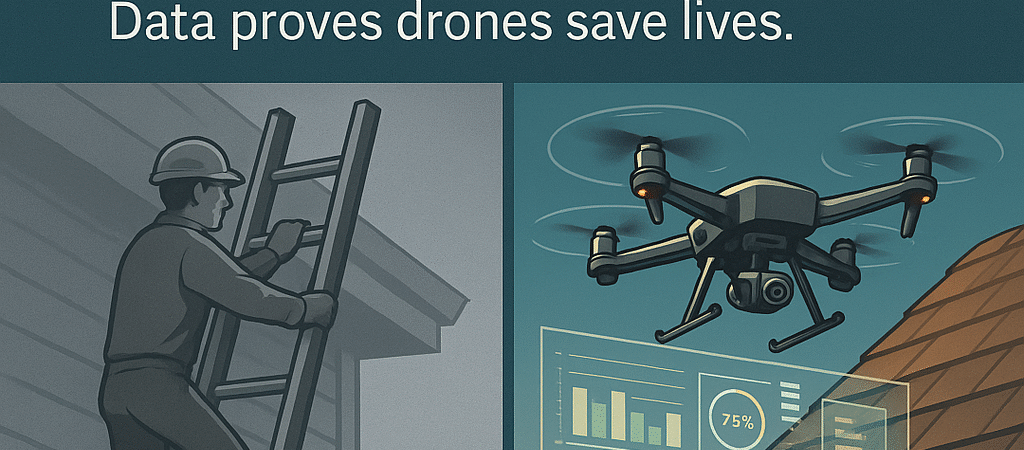
Every year, over 22,000 workers are injured and 161 die from ladder-related falls in the U.S.Comparative Safety_ Ladders vs.…. Meanwhile, across five years of FAA Part 107 drone operations, there have been fewer than 200 total reported incidents and no fatalitiesComparative Safety_ Ladders vs.…. That’s not just progress — it’s proof of a systemic safety revolution.
This research compares ladder-based inspection risks against FAA-certified drone operations, using verified OSHA, NIOSH, and FAA data. It reveals a staggering truth: replacing ladders with drones isn’t just safer — it’s statistically one of the most effective risk-reduction strategies in modern industry. With OSHA and NIOSH both formally recognizing drones as a legitimate compliance and safety enhancement toolComparative Safety_ Ladders vs.…, adopting aerial inspections now carries both moral and financial weight.
For contractors, insurers, and corporate safety officers, the takeaway is clear: every ladder replaced with a drone is a liability removed, a life preserved, and a cost prevented.
Ladder Fall Hazards
Workers climbing extension or step ladders face a high risk of falls. In fact, ladder-related falls are a leading source of occupational injuries. NIOSH reports that in 2020 there were 22,710 workplace injuries from ladders (and 161 fatalities) in the U.S.cdc.gov. OSHA notes that falls from ladders account for roughly 20% of all fatal and lost-workday injuries in general industry (making the toll “sobering”)cdc.gov. These statistics underline that manual ladder use remains a frequent and dangerous activity. Without proper training, fall protection or safer alternatives, workers on ladders face a significant probability of injury.
- Key Ladder Safety Data: In 2020, NIOSH recorded 22,710 injuries and 161 deaths from ladder fallscdc.gov. Ladder falls cause roughly one-fifth of all fatal occupational falls. OSHA’s ladder safety standard and training emphasize these high injury counts. Employers are urged to follow OSHA’s guidelines (e.g. 29 CFR 1926.1053) on safe ladder setup, fall restraints, and worker training to mitigate this pervasive risk.
Part 107 Drone Safety Record
By contrast, the FAA’s Part 107 (commercial drone) program shows a very low incident rate. A recent study of FAA/NASA data found only 187 reported Part-107 incidents in the U.S. from January 2019 through June 2024mdpi.com. The number of drone incidents has been growing (about 51 per year since 2021mdpi.com) but remains tiny relative to ladder injuries. Crucially, there have been no known major accidents or fatalities involving Part-107 drones to datemdpi.com. In fact, FAA and industry sources emphasize that the Part 107 rules and reporting (14 CFR 107.9) have proven effective: “no major accidents involving commercial flights in the more than eight years since Part 107 in 2016”mdpi.com. This strong safety record reflects strict FAA regulations (pilot certification, visual line-of-sight, airspace authorizations, etc.) and growing operational maturity in the sUAS sector.
- Key Drone Safety Data: Only 187 Part-107 incidents reported (Jan 2019–Jun 2024)mdpi.com. By comparison, 22,710 ladder injuries occur per yearcdc.gov. The FAA’s database (via Part 107 reporting) shows no serious injuries or deaths from these incidentsmdpi.com. (Public data suggest hundreds of near-misses, but no drone-related fatalities have been recorded under Part 107.) In short, commercial drone flights under Part 107 have a far lower reported incident count than routine ladder use.
OSHA/NIOSH Guidance and Industry Practice
Regulators and safety experts explicitly recognize that drones can mitigate high-risk inspection tasks. OSHA’s policy memo on UAS says OSHA “may use” drones to collect inspection evidence “in areas that are inaccessible or pose a safety risk to inspection personnel.”osha.gov. In other words, OSHA endorses UAVs as a tool to avoid sending inspectors into danger (e.g. atop tall equipment or unstable structures). Similarly, NIOSH and research studies highlight drones’ benefits for fall-hazard reduction. For example, a NIOSH safety blog notes that UAVs “have the potential to prevent injury and death in the construction industry” by reducing falls and other hazardsblogs.cdc.gov. Research on automated fall-hazard monitoring observes that “UASs can provide several advantages…as they can move faster than humans, reach inaccessible areas of jobsites”researchgate.net. In practice, companies use drones to inspect roofs, towers, bridges and confined spaces—tasks that otherwise require workers to climb ladders or scaffolds. These inspections “may be more efficient, safer and less costly” than manual methodsblogs.cdc.gov. In fact, studies conclude that using UAVs for tall-structure inspections (where workers would otherwise risk falling) “appears to be a clear benefit for [worker] safety”blogs.cdc.gov.
- OSHA/NIOSH Insights: By keeping personnel on the ground, drones substantially lower the exposure to height-fall risks. NIOSH warns that UAV inspections can “help reduce…injury and death from falls” and other hazardsblogs.cdc.gov. OSHA’s enforcement guidance similarly allows UAS use for high-risk inspections (with employer consent and compliance with Part 107)osha.gov. In short, both OSHA and NIOSH view drones as a safety-enhancing technology: one that can improve compliance by expanding inspection capability while cutting the need for workers to perform dangerous climbs.
Policy and Safety Implications
Overall, available data and expert guidance show that drone inspections pose far less risk than ladder-based inspections. The sheer scale difference (tens of thousands of annual ladder injuries vs. a few hundred drone incidents in five years) makes the contrast starkcdc.govmdpi.com. Agencies and companies increasingly recognize this: incorporating UAVs into routine safety programs can prevent falls, reduce lost-workday injuries, and even catch hazards before they become incidents. For example, automated drone surveys can identify fall hazards in real time without sending a human aloftresearchgate.net. This proactive approach aligns with OSHA’s “prevention through design” goals and NIOSH’s fall-prevention agenda.
In summary, climbing ladders remains a high-risk activity with a long history of injury. In contrast, FAA Part 107 drone operations have a strong safety record: only hundreds of incidents are logged, with no fatalities, and regulators explicitly allow UAVs to protect inspectors from fall hazardsmdpi.comosha.gov. The data suggest that where drones can substitute for ladder work (for inspections, monitoring, etc.), they offer a safer compliance option and are likely to reduce OSHA-recordable incidents significantlyblogs.cdc.govblogs.cdc.gov.
Sources: Official FAA and NASA data show ~187 Part 107 incident reports (2019–2024)mdpi.com. OSHA/NIOSH publications report ~22,700 ladder fall injuries per yearcdc.gov. OSHA policy memos and NIOSH analyses explicitly discuss drones as safety aids (citations above). All facts are drawn from these government and peer-reviewed sources.