TL;DR — Executive Summary
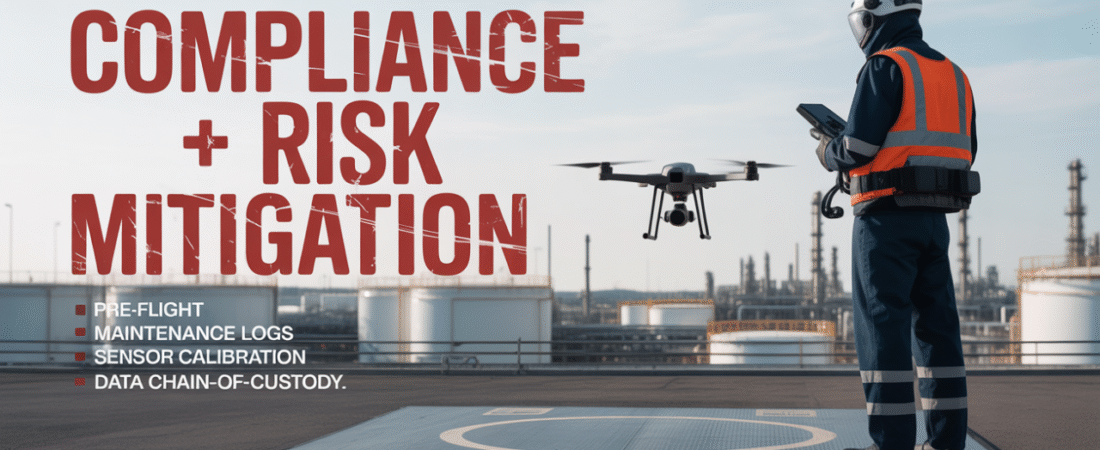
Professional UAS inspection programs go far beyond basic Part 107 compliance. They rely on formal SOPs, structured airworthiness and maintenance management, and defensible documentation to reduce technical and legal risk. RPICs must verify aircraft readiness, registration, Remote ID, and environmental feasibility before each mission; data-dependent payloads require calibration to avoid E&O exposure.
Post-flight, operators must perform technical inspections, log corrective actions, archive mission data, maintain chain of custody, and delete unnecessary non-contractual imagery to reduce liability.
Robust documentation directly influences insurance underwriting, enabling favorable UASL, Hull, and E&O coverage—often mandatory for industrial clients. Demonstrably professional record-keeping, proactive safety culture, and contractual risk transfer (COI, additional insured) are the foundations of a mature commercial drone inspection program.
I. The Foundation of Professional UAS Operations: Compliance and Culture
Professional Unmanned Aircraft System (UAS) operations, particularly those involved in high-stakes aerial inspections, fundamentally diverge from recreational flying through formalized risk transfer, standardized procedures, and detailed accountability protocols. While hobbyists generally adhere to 14 CFR Part 101 or specific community-based organization (CBO) rules, commercial operators are explicitly governed by the strictures of 14 CFR Part 107 (Small UAS Rules).1 This regulatory framework serves as the minimum acceptable standard, but professional practice elevates requirements well beyond mere compliance.
A. Differentiating Professional Inspection Operations from Hobbyist Flying
Professional entities accept significantly amplified liability exposure due to client contracts and the high value of the infrastructure being inspected. Consequently, professional practice requires comprehensive, auditable documentation.2 This documentation—encompassing maintenance logs, pre-flight assessments, and Standard Operating Procedures (SOPs)—serves the dual purposes of assuring operational safety and establishing legal defensibility in the event of an incident.
The legal consequence of meticulous record-keeping cannot be overstated. When the Federal Aviation Administration (FAA) mandates the Remote Pilot-in-Command (RPIC) to assess the condition of the small UAS for safe operation and document that assessment for verification 1, this administrative action transforms into a legal necessity. If an operational failure occurs and subsequent litigation ensues, the detailed pre-flight assessments and continuous maintenance records become the primary evidence demonstrating that the required standard of care was met. This administrative rigor functions as the primary “legal shield” against potential claims of negligence. Therefore, a failure to log a simple component check can convert an operational oversight into a significant vulnerability to civil liability or even charges of regulatory non-compliance.
B. Establishing a Proactive Safety Culture and Organizational Structure
A professional operation must formalize its approach to safety through a defined organizational structure and mandatory procedures. Standard Operating Procedures (SOPs) are the operational blueprints that standardize workflows, significantly reducing the probability of human error and ensuring consistent regulatory adherence across all missions.4 These SOPs must define critical mission phases, mandate equipment calibration schedules, establish comprehensive emergency contingency plans, and formalize internal processes.3
Furthermore, specific roles must be delineated to enforce accountability. The UAS Coordinator holds an essential administrative and oversight role, responsible for maintaining comprehensive documentation files, including copies of training records, flight incident reports, and detailed maintenance logs.3 This ensures that the organization, as a whole, remains current with all federal and state regulations. In contrast, the Remote Pilot-in-Command (RPIC) is directly responsible for the overall safety of the specific mission execution and must confirm the aircraft is airworthy and compliant before takeoff.1
II. Regulatory Airworthiness and Rigorous Maintenance Management
Compliance with airworthiness standards requires transforming sporadic repairs into a structured, auditable maintenance program. This structure is mandated by 14 CFR Part 107 and aligns with traditional aviation safety principles.
A. Mandatory Airworthiness Documentation and Compliance
Before any launch, professional operators must verify that all regulatory paperwork for the pilot and the platform is current. This involves confirming the pilot’s Part 107 certificate is up-to-date, verifying drone registration and proper number display, and ensuring Remote ID functionality is operational.5 Airspace management is a critical pre-flight step, demanding the consistent use of authorized tools such as B4UFLY or LAANC to verify flight restrictions, secure necessary authorizations (waivers), and review height and speed limits specific to the authorized operating area.5
B. Maintenance and Preventive Maintenance Record Keeping
The FAA explicitly requires detailed and auditable records for all maintenance activities performed on the small UAS. Records of maintenance, preventive maintenance, and alterations must comprehensively detail the description of the work performed, the exact date the work was completed, and the name of the person who performed the work.1
This documentation standard extends to the tracking of life-limited components. Specific documentation must be maintained regarding the status of Life-Limited Parts (LLPs)—such as high-cycle motors, structural components, or battery cycles—to predict and prevent catastrophic in-flight failures.1 All such required records must be actively maintained and made available immediately upon request from the FAA Administrator or the National Transportation Safety Board (NTSB).1
The systematic documentation of maintenance becomes a crucial factor in operational economics. Insurance carriers, when assessing operational risk and setting premiums, prioritize demonstrated safety controls and operational history.6 Robust, verifiable maintenance logs directly attest to an organization’s commitment to airworthiness and safe operations, effectively lowering the probability of accidents stemming from equipment failure. Organizations that can present professional, auditable maintenance records are seen as lower risk by underwriters, which often results in reduced insurance premiums or more favorable terms for Hull and Liability coverage.6 Thus, maintenance documentation is not merely a regulatory compliance burden but a strategic financial asset that actively lowers the overall cost of risk transfer.
Table 1: UAS Airworthiness and Maintenance Record Requirements
| Record Component | Regulatory Requirement (FAA Part 107 Reference) | Purpose in Professional Operations |
| Maintenance/Preventive Maintenance Log | Description of work, date completed, name of person who performed the work 1 | Proof of airworthiness and compliance; required for accident investigation defense. |
| Status of Life-Limited Parts (LLPs) | Tracking remaining operational life/cycles 1 | Predictive failure mitigation; required for larger/Category 4 aircraft transfer.1 |
| Pre-Flight Assessment | Documentation that the sUAS is safe for operation 1 | Verifiable operational readiness; links ground inspection findings to airworthiness. |
| Training/Operator Records | RPIC certificates, currency, and incident reports (Internal SOP) 3 | Proves pilot competence and adherence to organizational safety culture. |
III. Standardized Operational Procedures: Pre-Flight, In-Flight, and Emergency Protocols
A professional mission is conducted across distinct phases, requiring adherence to a rigorous, multi-faceted checklist that confirms regulatory compliance, environmental suitability, and system readiness.
A. Phase 1: Pre-Flight Mission Planning and Regulatory Compliance
This initial, often desk-based, phase verifies the mission’s legal and environmental feasibility. It involves a regulatory compliance check, confirming the pilot’s license, drone registration, and the Remote ID status.5 Concurrently, a detailed environmental and weather assessment is mandatory, reviewing the weather forecast and prevailing wind conditions for the full duration of the planned flight, often incorporating formalized wind speed limits defined within the SOPs.7
Crucially, a site safety risk assessment must be performed, including thoroughly checking the operational environment for hazards such as overhead wires, pylons, and cables.7 Safety cones and barriers should be deployed to establish and mark the fly zone, ensuring the clearance of the general public and bystanders. The RPIC must also confirm visual line of sight (VLOS) of the drone can be maintained at all times by taking stock of the topography.7
B. Phase 2: Pre-Flight Aircraft and System Inspection Checklist
The physical inspection phase ensures mechanical and electronic integrity. Equipment checks involve visually inspecting the airframe, propellers, landing gear, and motor mounts for any sign of damage, wear, or swelling.5 Battery health management is paramount; voltage, temperature, and overall condition must be checked, with immediate removal from service mandated if swelling is detected.5
System verification is equally crucial for inspection missions. Operators must confirm sensor calibration is accurate and current, verify robust GPS signal strength and satellite connections, and ensure firmware and software are current.5 Before takeoff, a control check of all flight controls must be performed to ensure proper responsiveness.5
C. Phase 3 & 4: In-Flight Management and Emergency Contingency Planning
Standardizing in-flight procedures minimizes risks. A low-altitude range test should be conducted to confirm the integrity of the radio link, and camera settings (resolution, exposure) must be checked to guarantee the quality of the collected inspection data.7
Detailed emergency planning protocols are necessary to prevent minor malfunctions from escalating into critical incidents. SOPs must define precise procedures for loss of GPS signal, lost communication link, immediate abort scenarios, and designation of pre-determined emergency landing zones.7 Clear, mandatory communication standards between the RPIC, Visual Observer (VO), and ground crew are non-negotiable for maintaining overall situational awareness.
For inspection services, where the primary deliverable is data integrity, the rigor applied to the checklist must extend beyond mere airworthiness to include the readiness of the data payload. Inspection services often utilize specialized sensors for photogrammetry or thermal imaging.8 If an inspection is rendered useless due to inaccurate data resulting from a failure in sensor calibration—a procedural omission during the pre-flight phase 5—the client could pursue damages based on negligent service. By documenting mandatory sensor calibration verification, the operator provides crucial defense against professional liability claims (Errors and Omissions, or E&O) by demonstrating that the required professional standard of care was met before the data collection mission commenced.9
Table 3: Critical Pre-Flight System and Environmental Checklist Items
| Category | Specific Check | Professional Rationale | Source |
| Regulatory | Pilot License & Remote ID Status | Ensures legal operation and traceability. | 5 |
| Environmental | Wind Speed and Site Clearance | Mitigates risk of loss of control and protects third parties. | 7 |
| System Health | Battery Status (Voltage, Temp, Condition) | Prevents in-flight power failure and identifies potential hazards (swelling). | 5 |
| Navigation | GPS Lock/Satellite Count & Sensor Calibration | Ensures stable flight path and accurate, geo-referenced inspection data. | 5 |
| Safety | Safety Kit/Flight Zone Marking | Protects operating crew (Hi-viz, hard hat) and segregates the public (cones). | 7 |
IV. Post-Flight Procedures and Data Integrity for Inspection Missions
The post-flight phase transitions from operational safety to evidence management and continued airworthiness assurance, both of which are critical for inspection companies.
A. Post-Flight Aircraft Inspection and Corrective Action Documentation
Upon completion of the mission, a formal post-flight inspection must be conducted to assess the immediate impact of the flight and identify required corrective actions. This includes inspecting the airframe, propellers, motors, and landing gear for any signs of fatigue or damage from landing.5 Flight logs must be analyzed to review metrics such as battery usage, peak environmental stresses, and any generated error codes. Any required maintenance or detected issues are formally documented and fed directly into the continuous maintenance records system.1
B. The Criticality of “Before” and “After” Documentation Protocols
For inspection services, the deliverable is validated data, making documentation continuity and evidence integrity essential. The operator must log comprehensive mission metadata, including the date, time, location, mission objective, environmental parameters, and specific equipment settings used.8
The documentation cycle must capture the state of the asset before the inspection (e.g., existing visual evidence or previous reports) to establish a baseline. The core of the professional service, however, lies in the “after” documentation—the systematic process of downloading, reviewing, processing, and analyzing the collected visual data, as the thorough visual inspection work primarily occurs post-flight.8 The collected evidence must be timestamped, accurately georeferenced, and stored securely to maintain a robust chain of custody. This meticulous documentation of all inspection processes provides crucial protection for the company if an accident occurs or if litigation arises alleging a failure to detect a critical flaw during the inspection.2
The dexterity of modern UAS platforms, which allows them to capture a wide variety of information without constraints 10, often results in the unintended collection of sensitive “bulk data,” such as geolocation data or imagery of non-target assets.10 This unnecessary data, collected incidentally during complex missions, significantly expands regulatory compliance burdens (e.g., data privacy laws) and increases liability exposure during legal discovery, where attorneys may seek any data that could implicate negligence. To mitigate this systemic risk, professional SOPs must define a process for the prompt and secure deletion of non-essential data while meticulously retaining only the necessary, contractually obligated inspection evidence.11 Data retention, therefore, is managed as a legal compliance measure rather than a simple storage issue.
V. Risk Mitigation: Liability, Insurance, and Contractual Requirements
The financial and legal foundation of professional operations relies on moving beyond personal liability to a corporate, systematic management of risk, especially for negligent service.
A. Differentiating Liability Exposure
The financial divide between hobbyist and professional operation is vast, requiring specialized insurance coverages. General Liability Insurance covers third-party bodily injury and property damage resulting from the drone’s operation, addressing the risk of physical accidents.12 However, for inspection services, Professional Liability Insurance, also known as Errors and Omissions (E&O) coverage, is essential. This policy protects the operator against claims of financial harm or loss suffered by the client due to professional errors, negligence, or a breach of the required standard of care during the provision of the inspection service.9
B. Essential Commercial Insurance Coverages
Professional commercial operations must utilize specialized policies designed for aviation risks, as standard Commercial Package Policies or Business Owners Policies almost universally contain an “aircraft exclusion” clause.6 Relying on general business insurance is a critical operational vulnerability because the general insurer will deny a claim related to the drone, necessitating specific coverage.
The essential coverages are:
- Unmanned Aerial System Liability (UASL) and Ground Operations Liability: This coverage is mandatory for commercial use and is typically required by clients at a minimum of $1 million USD.6 UASL covers liability during flight, while Ground Operations Liability covers incidents occurring during non-flight phases like setup or maintenance.12
- Hull Insurance (Physical Damage): This protects the substantial capital investment in the drone airframe, payload, and associated equipment against physical damage, theft, or vandalism. Hull policies typically operate on an “agreed value” basis and include a deductible, often calculated as 5 percent to 10 percent of the drone’s value.6
- Professional Liability / Errors and Omissions (E&O): For service-based work such as infrastructure inspection, this policy addresses the critical risk that flawed data or analysis provided to the client results in financial loss.9
C. Contractual Requirements and Client Trust Management
Proof of comprehensive risk mitigation is often a prerequisite for high-value client contracts. Clients, particularly in regulated industries, will mandate a Certificate of Insurance (COI) before any operations begin.12 Furthermore, it is standard practice for clients to require the UAS operator to name them as an “additional insured” on the UASL policy. This contractual requirement extends protection to the client for the duration of the job, serving as a significant trust-builder and a key requirement for securing the contract.6
While operators do not manufacture the drones they fly, rigorous documentation of pre-flight checks and maintenance logs is vital for product liability mitigation. If an incident is definitively caused by a defective component, clear documentation proves the operator exercised due diligence and was not negligent in utilizing potentially faulty equipment, thereby aiding in shifting liability back to the manufacturer.2
Table 2: Comparative Analysis of Professional vs. Hobbyist Operations
| Operational Aspect | Hobbyist/Recreational | Professional/Commercial Inspection |
| Primary Regulatory Guide | Part 101 or CBO rules | Mandatory 14 CFR Part 107 |
| Standard Procedures | Informal, general safety guidelines | Mandatory, formalized Standard Operating Procedures (SOPs) 4 |
| Minimum Liability Coverage | None required (basic recommended) | Typically $1M USD minimum (Mandated by client/industry) 6 |
| Documentation Scope | Minimal or none | Exhaustive: Maintenance logs, Pre-flight checks, Flight logs, and Auditable Inspection Data 2 |
| Essential Insurance | Hull recommended; General Liability sufficient for basics | UAS Liability (UASL), Hull, and Professional Liability (E&O) required [9, 12] |
Table 4: Commercial UAS Insurance Toolkit (Coverage Types)
| Policy Type | Risk Covered | Relevance to Aerial Inspections | Source |
| UAS General Liability (UASL) | Bodily injury or property damage to third parties caused by the drone/operation. | Essential foundation; protects against physical accidents (crashes). | 6 |
| Professional Liability (E&O) | Financial harm/damage resulting from negligent performance of service or data errors. | CRITICAL: Protects against claims arising from flawed inspection reports or missed defects. | 9 |
| Hull Insurance | Physical damage or loss (theft, crash, vandalism) to the drone airframe/payload. | Protects the capital investment in expensive enterprise equipment. | 6 |
| Ground Operations Liability | Incidents occurring during setup, breakdown, or transportation. | Ensures continuous protection when the drone is not airborne. | 12 |
VI. Conclusion: Integrating Safety Culture and Compliance for Operational Excellence
The transition to professional aerial inspection operations requires the seamless integration of operational safety rigor with a structured legal and financial framework. Professional status is defined not merely by holding a Part 107 certificate, but by managing the systemic complexity of continued regulatory compliance, system airworthiness, auditable data integrity, and complex, multi-layered liability exposure.
The comprehensive documentation mandate—from the pre-flight checklist verifying battery health and sensor calibration 5 to the meticulous logging of all maintenance 1—serves as the cornerstone of the professional standard. This administrative diligence is instrumental in mitigating systemic risk and providing a robust defense against litigation.
For specialized Aerial Inspections, the financial protection offered by General Liability must be complemented by Professional Liability (E&O) coverage to address the inherent risks associated with providing expert data and analysis. Furthermore, Standard Operating Procedures (SOPs) must enforce a strict data retention policy that proactively and securely deletes non-essential data to minimize unnecessary legal and privacy exposure.10 The holistic adoption of these standards—formal SOPs, verifiable airworthiness logs, and a specialized UAS insurance portfolio—is the critical differentiator that justifies commercial pricing, secures client trust, and prepares the organization for future regulatory changes and expanded operational demands.
Works cited
- 14 CFR Part 107 — Small Unmanned Aircraft Systems (FAR … – eCFR, accessed October 31, 2025, https://www.ecfr.gov/current/title-14/chapter-I/subchapter-F/part-107
- What Every Aviation Company Should Know About Liability in Drone-Related Incidents, accessed October 31, 2025, https://www.hargeraviationlaw.com/blog/what-every-aviation-company-should-know-about-liability-in-drone-related-incidents/
- UAS STANDARD OPERATING PROCEDURES – Connect NCDOT, accessed October 31, 2025, https://connect.ncdot.gov/resources/Aviation%20Resources%20Documents/NCDOT_UAS_SOP.pdf
- accessed October 31, 2025, https://www.flyeye.io/drone-acronym-sop/#:~:text=Drone%20pilots%2C%20organizations%2C%20and%20regulatory,calibration%2C%20and%20emergency%20contingency%20plans.
- The Ultimate Drone Preflight Checklist – Expert Strategies for Safe and Successful Flights, accessed October 31, 2025, https://blog.dronedesk.io/drone-preflight-checklist/
- Drone Insurance Guide 2025: Costs, Coverage & Best Providers – JOUAV, accessed October 31, 2025, https://www.jouav.com/blog/drone-insurance.html
- Critical factors to consider in a drone pre-flight checklist – COPTRZ, accessed October 31, 2025, https://coptrz.com/blog/the-critical-factors-to-consider-in-a-drone-pre-flight-checklist/
- Drone Inspection Guide: Benefits & Industries Served – Flyability, accessed October 31, 2025, https://www.flyability.com/blog/drone-inspections
- Drone Liability Insurance | InsuredBetter, accessed October 31, 2025, https://www.insuredbetter.com/professional-liability-insurance/pilot-coverage/commercial-drone-insurance/
- Opinion 01/2015 on Privacy and Data Protection Issues relating to the Utilisation of Drones – European Commission, accessed October 31, 2025, https://ec.europa.eu/newsroom/article29/redirection/document/56119
- I. INTRODUCTION The benefits of commercial and private unmanned aircraft systems (UAS) are substantial. Technology has moved fo, accessed October 31, 2025, https://www.ntia.gov/files/ntia/publications/ntiauas-dma_redline.pdf
- Drone / Unmanned Aerial Systems (UAS) Insurance 101: A Comprehensive Guide for Commercial Operations – Henriott, accessed October 31, 2025, https://henriott.com/drone-unmanned-aerial-systems-uas-insurance-101-a-comprehensive-guide-for-commercial-operations/
Understand the regulations and risks of Drones – PUI – Professional Underwriters, accessed October 31, 2025, https://www.profunderwriters.com/understand-the-regulations-and-risks-of-drones/