
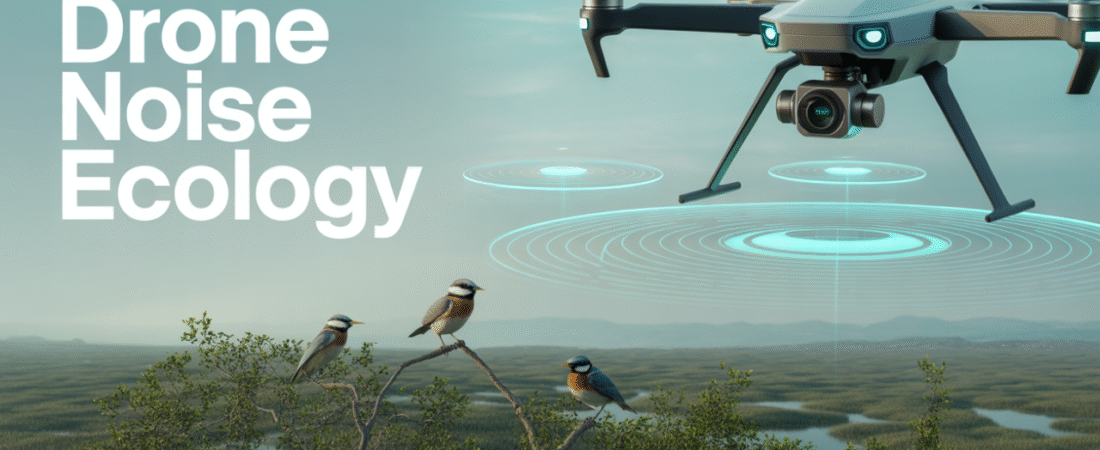
TL;DR
Commercial UAS fleets emit dominant tonal noise centered around the blade-pass frequency (100–300 Hz) and strong harmonic overtones extending into the 2–5 kHz range. These spectral bands directly overlap the communication channels of amphibians, fish, and especially songbirds, leading to acoustic masking, chronic stress, and reduced reproductive success. BVLOS fleet operations intensify exposure, creating persistent noise corridors that degrade habitat and drive displacement. Altitude-based mitigation is mathematically unworkable—reducing an 80 dB drone to 35 dBA requires ~1,340 m AGL—so true solutions must focus on source reduction: biomimetic propellers, spectral shifting, ring-shrouded blade geometries, and platform selection (favoring fixed-wing/eVTOL over coaxial multirotors). Future regulations must emphasize frequency-specific limits and formal EIAs to safeguard sensitive ecosystems.
1. Executive Summary
The widespread integration of Unmanned Aerial Systems (UAS), particularly for Beyond Visual Line of Sight (BVLOS) operations, represents a paradigm shift in environmental acoustics, transitioning from localized human annoyance to chronic ecological disturbance. Analysis confirms that commercial drone noise poses a significant, persistent threat to biodiversity through acoustic masking.
Aeroacoustic Findings: The primary noise signature of commercial drones is dominated by low-frequency tonal components, specifically the Blade Pass Frequency (BPF) fundamental, typically ranging between 100 Hz and 300 Hz.1 While the unweighted fundamental is low, strong harmonics of the BPF extend critically into the kilohertz range.1 Multirotors, particularly those employing coaxial propeller designs, consistently exhibit the highest overall sound pressure levels (SPL), increased broadband noise, and the greatest perceived psychoacoustic annoyance.3
Critical Bio-Acoustic Conflicts: The drone acoustic profile creates severe potential for acoustic masking across two distinct and critical biological communication bands:
- Low-Frequency Vulnerability (100 Hz–300 Hz): The BPF fundamental directly overlaps the primary hearing range of amphibians and generalist fish species.4
- Mid-Frequency Vulnerability (2 kHz–5 kHz): Strong drone harmonic overtones align perfectly with the peak hearing sensitivity and communication range of critical avian populations, specifically songbirds.6
BVLOS Implications: Relying on operational altitude (Above Ground Level, AGL) for noise mitigation is unsustainable. To achieve the regulatory target of 35 dBA at ground level, a noisy consumer multirotor (80 dB acoustic footprint) would require an impractical operation height of 1,340m AGL, while even a quiet commercial multirotor (59 dB) requires 120m AGL.8 This discrepancy confirms that widespread BVLOS implementation using current technology poses an unavoidable risk of chronic habitat displacement and regulatory non-compliance without active source noise reduction.
Strategic Recommendations: Future regulatory compliance must mandate frequency-specific spectral density limits rather than simple broadband dBA metrics. Research and development must prioritize “bio-acoustic stealth” technologies, particularly microstructural propeller geometries designed to suppress broadband noise and attenuate BPF harmonics in the ecologically critical 2–5 kHz band.9
2. Introduction: The Emerging Soundscape of Drone Logistics
The rapid maturation of Unmanned Aerial Systems (UAS) technology has spurred ambitious plans across commercial sectors, spanning logistics, surveillance, and mapping. This proliferation is heavily reliant on the adoption of high-volume, Beyond Visual Line of Sight (BVLOS) operations, exemplified by regulatory authorizations for large-scale fleets, such as the integration of the Amazon Prime Air MK30 UAS.10 While BVLOS offers substantial logistical efficiency, its deployment introduces a pervasive, chronic source of acoustic energy into previously undisturbed environments, necessitating a shift in assessment focus from mere human annoyance to detailed ecological disturbance.
Environmental acoustic assessment is imperative because anthropogenic noise affects biological systems through physiological stress, behavioral alteration, and the fundamental disruption of acoustic communication pathways.11 The acoustic signature of a drone is inherently different from conventional transportation noise (e.g., cars or fixed-wing aircraft), often perceived as more annoying to human observers due to its unique tonal characteristics.1 This heightened negative psychoacoustic response suggests a correspondingly high potential for inducing stress and avoidance behaviors in wildlife.
A foundational understanding of drone noise necessitates an introduction to key aeroacoustic concepts. Unlike jet engines or piston-driven aircraft, the primary source of noise in commercial UAS is the rotating propeller blade.12 This noise is divided into two primary categories: tonal noise, characterized by discrete, periodic frequencies tied to the mechanical rotation rate; and broadband noise, which is continuous and results from turbulent flow phenomena, such as vortex shedding.12 The acoustic interaction between the UAS platform and the environment—the field of acoustic ecology—demands a rigorous analysis of where these specific frequency components intersect with the communication ranges of vulnerable wildlife species.
3. Aeroacoustic Characterization of Commercial UAV Fleets
3.1 Fundamental Noise Generation Mechanisms in UAVs
The defining characteristic of the Unmanned Aerial Vehicle (UAV) acoustic signature is the dominance of propeller noise. Although modern commercial drones rely on brushless electric motors that are intrinsically quiet, the aerodynamic interaction of the rotating blades with the air generates the vast majority of the emitted sound energy.12
Tonal Components and the Blade Pass Frequency (BPF)
Tonal noise is the result of deterministic physical processes related to the geometry and operation of the propeller. Specifically, the sound is generated by the cyclical changes in blade thickness and the surface aerodynamic loading as the blade passes a fixed point in space.12 This process yields a rigorously periodic sound with a discrete frequency spectrum, classically modeled using the Ffowcs-Williams Hawkings equation.12
The fundamental frequency of this tonal noise is the Blade Pass Frequency (BPF). For most small commercial multirotors, the BPF fundamental is located within the low-frequency range of 100 Hz to 300 Hz.1 The BPF dominates the overall noise level, and its subsequent harmonics (multiples of the fundamental frequency) can be extremely strong, with measurable intensity extending into the several kilohertz (kHz) range.1 For instance, a two-bladed propeller with a rotational frequency yielding 136.6 Hz as the fundamental BPF has overtones that maintain high noise levels, demonstrating the spectral persistence of this mechanism.2
Broadband Noise and Psychoacoustic Effects
In addition to the discrete tonal components, rotating blades also generate broadband noise, characterized by a continuous frequency behavior.12 This noise component is primarily produced by turbulent flow phenomena, such such as the shedding of vortices, particularly at the blade tips and trailing edges. While the risk for hearing damage from typical commercial drones is low—overall sound levels are comparable to many household appliances at short distances—the unique sound characteristics are highly disruptive.1 The distinct “buzz” of a drone, unlike the continuous rumble of trucks or cars, immediately grabs attention, leading to distraction and annoyance in humans.1
The acoustic profile of commercial drones presents a dual ecological threat. The persistent, low-frequency BPF fundamental (100–300 Hz) constitutes a primary disturbance mechanism for species that rely on low-frequency communication and environmental vibration sensing, such as amphibians and generalist fish.4 Concurrently, the robust high-frequency BPF harmonics (extending into the 2–5 kHz range) present a critical threat of acoustic masking to sensitive avian populations.6 Therefore, effective acoustic mitigation cannot focus solely on overall SPL but must address both the low-frequency fundamental and its high-frequency overtones. This necessitates careful consideration of the aerodynamic design, as maximizing propeller efficiency often involves higher tip speeds which, in turn, intrinsically amplify these high-frequency BPF harmonics.12
3.2 Comparative Acoustic Signatures Across UAV Architectures
The overall acoustic burden and spectral characteristics vary significantly depending on the UAV architecture.
Multirotor Configurations
Multirotor aircraft, exemplified by quadcopters, are the most common commercial platform and typically register noise levels around 55 dBA at 100m AGL.8 However, their geometric configuration heavily influences their noise output.
Quadcopters equipped with coaxial propellers—where one propeller is stacked above another—are consistently identified as considerably noisier than their single-propeller counterparts.3 Acoustic analysis shows the coaxial design generates higher levels of broadband noise and greater spectral fluctuations across all frequencies.3 This increased acoustic emission is attributed to the interaction tones generated when the acoustic fields of the two propellers interfere.3 Psychoacoustic studies confirm this elevated disturbance profile, finding that the coaxial-propeller quadcopter was approximately three times more annoying than the single-propeller version, demonstrating the highest levels of loudness and impulsiveness.3
Fixed-Wing and Hybrid eVTOL Systems
In contrast, fixed-wing and hybrid eVTOL (Electric Vertical Take-Off and Landing) platforms generally present a lower acoustic burden. Small fixed-wing drones operating at 100m AGL have been recorded at approximately 50 dBA.8 More advanced eVTOL configurations, such as tailsitter vehicles, emit considerably lower noise levels overall compared to quadcopters, exhibiting reduced loudness and impulsiveness.3
However, the noise profile of eVTOLs is nuanced. While the tailsitter eVTOL was assessed as having the lowest values for loudness and impulsiveness, it was concurrently evaluated as the “sharpest” sound, indicating a higher proportion of high-frequency content.3 While this high-frequency content might be less annoying to human perception than the low-frequency rumble or distinct tones of a quadcopter, this characteristic must be critically assessed against species highly sensitive to high-frequency sounds, such as songbirds. The quadplane eVTOL, despite often operating with only a single propeller in forward flight, registered slightly higher noise levels than the tailsitter, particularly around the 100 Hz and 2,000 Hz bands.3
The following table summarizes the comparative acoustic characteristics, demonstrating the varying degrees of ecological and human disturbance potential posed by different drone architectures.
Table 1: Comparative Noise Emissions and Characteristics of Commercial UAV Platforms
| UAV Architecture | Example SPL (dBA @ 100m AGL) | Dominant Acoustic Characteristic | Psychoacoustic Assessment |
| Large Quadcopter (Standard) | 55 dBA | High broadband, strong BPF harmonics (kHz) | Significant annoyance due to tonal components 1 |
| Small Fixed-Wing Drone | 50 dBA | Generally lower SPL and potentially reduced tonal component | Reduced annoyance, often used for quiet surveillance 8 |
| Coaxial Quadcopter | >55 dBA (Relative) | High spectral fluctuation, propeller interaction tones | Highest annoyance, loudness, and impulsiveness 3 |
| Tailsitter eVTOL | Lowest dBA (Relative) | Lower overall noise, but highest “sharpness” (high-frequency content) | Lowest overall annoyance for humans 3 |
4. Bio-Acoustic Conflict: Frequency Overlap and Masking Effects
4.1 Principles of Acoustic Masking and Ecological Impact
Acoustic masking is the predominant mechanism through which anthropogenic noise disrupts wildlife communication. Masking occurs when the background noise sufficiently overlaps the spectral density of a vital biological signal—such as an alarm call, mating call, or territorial song—thereby reducing the organism’s ability to hear or correctly interpret that signal.13 Crucially, research has confirmed that disruption occurs only if the background noise aligns in frequency with the signal; noise of non-overlapping frequency, even if equally loud, does not compromise communication.14
The ecological consequences of masking are profound, triggering a cascading chain of negative impacts.11 Failure to detect essential environmental and animal signals leads to increased vigilance and reduced foraging efficiency, ultimately resulting in chronic physiological stress.11 In the long term, repeated masking can interfere with reproductive success, potentially leading to territory abandonment and subsequent population loss.11 Therefore, the critical assessment metric for drone fleets must be the analysis of spectral alignment, rather than focusing solely on overall sound pressure level (SPL). A noise source with a modest SPL that perfectly aligns with a species’ communication peak can be more ecologically damaging than a very loud noise source that operates outside that critical frequency band.
4.2 Frequency Spectrum Mapping: Drones vs. Wildlife Communication
The comparison of the drone acoustic spectrum against the vital communication ranges of various taxa reveals direct and concerning overlaps.
A. Avian Species (Songbirds)
Songbirds are highly vulnerable to drone noise, as their core communication range aligns precisely with the most prominent drone harmonic overtones. Songbirds, including species such as finches, exhibit maximal hearing sensitivity between 2 and 5 kHz, matching the peak frequency of their vocal communication signals.6 While human hearing extends up to 20 kHz, songbirds generally hear frequencies only as high as 10 kHz.7
The severe overlap occurs because the drone’s strong BPF harmonics—measured to extend well into the kilohertz range 1—fall directly within this vital 2–5 kHz band. Experimental assessments have demonstrated that when background noise overlaps the frequency of high-frequency “aerial” alarm calls, the birds are less likely to respond, concluding that reception is compromised primarily by masking.14 Consequently, widespread drone operations present a substantial threat to avian survival and reproductive continuity, as masking in this mid-frequency range compromises critical information transfer.
B. Chiroptera (Bats)
Bats primarily rely on ultrasonic frequencies for echolocation, navigation, and hunting.15 The frequency range perceptible to bats spans from approximately 20 Hz up to 150 kHz or 160 kHz.15 High-frequency sounds are utilized by most species for echolocation, such as the unique sounds produced by ghost-faced bats reaching 160 kHz.15
Direct masking of echolocation signals by commercial drones is highly improbable, given that drone noise typically dissipates significantly below 10 kHz.1 However, the drone spectrum does overlap the lower end of the bat hearing range. This lower range is often utilized for general hearing, detection of environmental sounds, and social communication.16 The overall impact on navigation and hunting is assessed as low, but there remains a potential for moderate interference with intra-species social organization and communication dynamics.
C. Amphibians and Generalist Fish
These species are uniquely vulnerable to the low-frequency characteristics of drone noise. Generalist predatory gamefish, such as bass, exhibit relatively limited hearing, struggling to perceive sounds above 200 Hz and typically not hearing anything above 600 Hz.4 They lack specialized structures (like the Weberian ossicles found in catfish) to amplify sounds beyond this low range.4 Similarly, amphibians utilize specialized internal ear structures, such as the saccule, which primarily detects vibrations and low-frequency sounds up to 100 Hz.5
The drone BPF fundamental (100 Hz–300 Hz) 1 falls directly across the core communication and vibration detection bands of these species. This high degree of alignment results in a high probability of masking vital cues, including amphibian mating calls and the detection of hydrodynamic signals generated by approaching predators or prey in aquatic environments.4 For amphibious habitats, chronic drone flyovers represent a direct disruption of fundamental reproductive processes.
D. Marine Life
Marine mammals exhibit broad hearing ranges, with high-frequency toothed whales (dolphins, porpoises) capable of hearing from 275 Hz up to 160 kHz, while larger whales specialize in low-frequency sounds, spanning from 10 Hz to 60 kHz.15
Acoustic energy from aerial drone operations transmits into the water column.17 Studies involving simple sound propagation models show that underwater received levels from passing drones can exceed ambient noise levels by up to 30 dB within the frequency band of 100 Hz to 10,000 Hz.17 This mid-range spectrum—which includes both the drone BPF fundamental and its lower harmonics—is actively used by various marine taxa for communication and sensing.
While current research suggests that localized acoustic effects from single drones are generally small compared to conventional aircraft or shipping, and documented behavioral reactions in marine mammals underwater are few 13, the deployment of large-scale BVLOS fleets introduces a critical cumulative risk. Persistent flight corridors could lead to chronic acoustic “smog,” raising the baseline ambient noise floor by significant amounts (e.g., 30 dB) in the 100 Hz–10 kHz band. Over time, this cumulative noise burden may force vocal species to expend more energy communicating or diminish their effective communication range, leading to chronic stress responses.11 The high spectral density of drone noise in the critical $100\,\text{Hz}$ to $10\,\text{kHz}$ band thus represents a subtle but pervasive ecological risk.
Table 2: Critical Frequency Overlap Assessment for Drone Noise and Wildlife Vulnerability
| Wildlife Taxa | Critical Communication/Hearing Range (Hz/kHz) | Drone Frequency Overlap (Hz/kHz) | Masking Severity | Vulnerable Mechanism |
| Songbirds | $2\,\text{kHz}$ – $5\,\text{kHz}$ (Peak) | Drone Harmonics (up to several kHz) | Severe | Masking of territorial song and high-frequency alarm calls 14 |
| Amphibians | $< 600\,\text{Hz}$ (Saccule up to $100\,\text{Hz}$) | BPF Fundamental ($100\,\text{Hz}$ – $300\,\text{Hz}$) | Moderate-High | Masking of mating calls and vibration detection 5 |
| Generalist Fish | $< 600\,\text{Hz}$ | BPF Fundamental ($100\,\text{Hz}$ – $300\,\text{Hz}$) | Moderate | Interference with detection of hydrodynamic signals 4 |
| Bats | $20\,\text{kHz}$ – $160\,\text{kHz}$ (Echolocation) | Minimal/None | Low | Echolocation unaffected, but potential masking of lower-frequency social calls 16 |
| Marine Life | $10\,\text{Hz}$ – $60\,\text{kHz}$ (Whales) | $100\,\text{Hz}$ – $10\,\text{kHz}$ (Transmitted) | Low/Cumulative | Localized degradation of the underwater soundscape above ambient levels 17 |
5. BVLOS Operations: Chronic Noise Pollution and Habitat Displacement
The shift toward large-scale, routine BVLOS operations fundamentally changes the nature of environmental disturbance from episodic acute events to persistent chronic pollution. This change has profound implications for habitat viability and regulatory compliance.
5.1 Ecological Ramifications of Chronic Exposure
While acute disturbances cause immediate flight or vigilance behaviors, the long-term ecological consequences of constant transportation noise are more insidious.13 Pervasive acoustic harassment fundamentally reduces the fitness and survival potential of noise-sensitive species. Chronic exposure to noise levels, even those below the threshold required to cause direct hearing loss (typically $85\,\text{dB}$ or higher), can induce significant non-auditory physiological effects, including increased heart rate and breathing.11 This persistent stress diverts metabolic energy away from critical functions like reproduction and foraging.
For wildlife populations, chronic acoustic stress leads to effective habitat degradation. Consistent acoustic masking and stress along drone flight corridors can force territory abandonment and result in reduced reproductive success.11 This phenomenon effectively reduces the usable habitat area, forcing species into less optimal or higher-density environments. Consequently, the planning of BVLOS corridors over sensitive ecosystems must require formal Environmental Impact Assessments (EIAs) that utilize noise prediction models, similar to the rigorous studies applied to large-scale surface mining operations to verify the effectiveness of mitigation measures.20
Currently, while the Marine Strategy Framework Directive (MSFD) explicitly protects marine biodiversity from underwater noise, comprehensive, prescriptive legislation targeting terrestrial biodiversity noise pollution does not exist in the same detail under European Birds and Habitats directives, leaving a regulatory gap for terrestrial ecosystems facing BVLOS expansion.13
5.2 Operational Altitude Requirements for Noise Mitigation (AGL Modeling)
A conventional approach to mitigating ground-level acoustic impact is increasing flight altitude (AGL). Regulatory targets often aim for a low threshold, such as 35 dBA at ground level, to minimize both human annoyance and environmental intrusion.8 However, achieving this relatively quiet standard requires operationally restrictive altitudes for most commercial platforms.
Data on existing UAV acoustic footprints demonstrate a fundamental operational dilemma. A quiet commercial multirotor with an acoustic footprint of $59\,\text{dB}$ requires a minimum altitude of $120\,\text{m}$ AGL to achieve $35\,\text{dBA}$ at ground level. In contrast, a louder consumer multirotor, possessing an $80\,\text{dB}$ footprint, requires an operationally prohibitive altitude of $1,340\,\text{m}$ AGL to meet the same target.8
This data establishes the noise-altitude paradox: a relatively small increase in the source noise level (from $59\,\text{dB}$ to $80\,\text{dB}$) necessitates an astronomically large increase in required altitude (from $120\,\text{m}$ to $1,340\,\text{m}$). This renders passive vertical separation an unsustainable strategy for large-scale, high-volume BVLOS fleets, particularly for last-mile delivery operations which must operate closer to the ground. Therefore, relying on altitude alone cannot serve as the primary compliance mechanism; the focus must shift decisively toward source noise reduction and acoustic stealth technologies.
Acoustic Propagation Complexity
Accurate noise prediction for BVLOS corridors is complex and relies on sophisticated acoustic propagation models. These models must account for several frequency-dependent atmospheric and environmental effects that influence the sound pressure level (SPL) received by a ground observer.21 Key factors include:
- Atmospheric Absorption: Sound attenuation in the air depends critically on frequency, temperature, humidity, and pressure. High-frequency acoustic energy attenuates much faster than low-frequency energy.22 This means that the high-frequency BPF harmonics that threaten songbirds (2–5 kHz) diminish rapidly with increasing altitude, but the persistent low-frequency BPF fundamental (100–300 Hz) propagates over much greater distances, posing a dominant, far-field threat to amphibians and fish.4
- Ground Effects: Models must integrate the effects of ground reflections and scattering due to atmospheric refraction. Failure to accurately reconcile factors like ground reflection models with empirical lateral attenuation models can lead to a “double-bookkeeping error,” resulting in significant underestimation of the actual ground-level SPL along flight paths.21
The implication of complex propagation dynamics is that BVLOS monitoring protocols must prioritize measuring the low-frequency acoustic energy content (100–300 Hz BPF), particularly over sensitive habitats, as this is the frequency band that persists longest in the propagation path and presents a continuous hazard.
Table 3: BVLOS Operational Altitude Requirements for Acoustic Compliance ($35\,\text{dBA}$ Target)
| UAV Model Type | Reference SPL (Acoustic Footprint dB) | AGL Required to Achieve 35dBA (Ground Level) | Implication for BVLOS Fleet Integration |
| Quiet Commercial Multirotor | $59\,\text{dB}$ | $120\,\text{m}$ | Baseline requirement for quiet operations 8 |
| Fixed Wing Petrol | $71\,\text{dB}$ | $480\,\text{m}$ | Requires dedicated high-altitude corridors 8 |
| Consumer Multirotor | $80\,\text{dB}$ | $1,340\,\text{m}$ | Unsuitable for low-altitude last-mile delivery compliance 8 |
6. Advancements in Bio-Acoustic Stealth and Noise Mitigation Technology
Addressing the challenge of ecological disruption caused by drone fleets requires moving beyond operational fixes, such as altitude restriction, toward fundamental engineering solutions in acoustic stealth.
6.1 Propeller Geometry Optimization and Bio-Inspired Design
The primary goal of advanced propeller design is suppressing the continuous spectrum noise generated by large-scale vortex shedding, which contributes significantly to broadband noise, particularly at the blade trailing edge.2
Emerging research has focused on microstructural solutions inspired by nature, leading to the development of bio-acoustic stealth. These designs utilize textures, often consisting of microscopic grooves and ribs, built directly into the blade structure.9 The function of this biomimetic texture is the precise management of airflow: the grooves stabilize the boundary layer close to the blade surface, while the ribs actively break up coherent vortices before they can shed and generate turbulent noise.9
This approach offers significant advantages: the pattern is integrated into the material, requiring no additional mass or maintenance.9 Crucially, simulations and measurements have demonstrated that this technology achieves substantial noise reduction specifically across the multiple kilohertz frequencies.2 The technological focus on reducing noise in this specific kilohertz range perfectly addresses the most critical identified ecological conflict—the masking of communication signals for sensitive avian populations (2–5 kHz). This confluence suggests that current R&D, although often driven by general noise targets, is highly effective in mitigating the specific bio-acoustic threat to songbirds.
6.2 Frequency Shifting and Noise Containment
Another advanced approach involves structurally manipulating the acoustic signature by shifting the BPF away from ecologically sensitive or human-annoying frequency ranges.
The HALO Ring Propeller Concept, developed by companies such as Northrop Grumman, utilizes a concentric hub-and-ring framework surrounding the propeller blades to reduce the radiated acoustic signature.9 This design operates by dynamically modifying blade aerodynamics to achieve two complementary effects: it raises the BPF while simultaneously reducing the blade tip speed.9 The intended effect is to move the resulting acoustic energy out of the frequencies that humans find most annoying, providing a psychoacoustic benefit.9 The ring structure also physically contains some acoustic energy that would otherwise radiate outwards.9
The future application of this technology lies in bio-acoustic signature tailoring. Instead of merely shifting noise for human comfort, the design strategy can be optimized for specific habitats, aiming for an acoustic signature that is either below the regulatory ambient threshold or shifted to a frequency band where no critical local species communicates (e.g., intentionally shifting the BPF fundamental away from the 100–300 Hz range to protect amphibians).
Furthermore, general low-noise design incorporates managing acoustic installation effects, where the airframe or fuselage characteristics are engineered to induce acoustic shielding or minimize sound scattering.3 Configurations such as eVTOL tailsitters inherently minimize propeller interaction noise, proving that holistic platform design can significantly reduce the overall noise footprint and perceived impulsiveness compared to complex, multi-layered propeller arrangements like coaxial quadcopters.3
7. Conclusions and Strategic Recommendations
The deployment of large-scale commercial drone fleets for BVLOS operations presents an unavoidable challenge to environmental acoustics, centered on the pervasive tonal noise generated by propellers. This analysis confirms a severe and bifurcated risk profile: the low-frequency BPF fundamental (100–300 Hz) threatens amphibians and fish, while the strong high-frequency harmonics (2–5 kHz) threaten sensitive songbird populations. Because operational altitude alone is an inefficient and often impractical mitigation strategy, the regulatory and commercial focus must pivot entirely to fundamental source noise reduction.
Strategic Recommendations
Based on the aeroacoustic and bio-acoustic analysis, the following strategic recommendations are essential for ensuring the sustainable integration of large BVLOS fleets:
Strategic Recommendation 1: Operational Platform Selection and Procurement Mandates
Regulatory authorities must strongly disincentivize the use of UAV platforms known to exhibit high acoustic burden and psychoacoustic annoyance. Specifically, coaxial-propeller multirotors should be restricted from BVLOS corridors over sensitive habitats due to their significantly higher broadband noise levels, increased spectral fluctuations, and pronounced annoyance factors.3 Preference should be given to streamlined fixed-wing or quiet eVTOL/tailsitter architectures that demonstrate intrinsically lower overall noise emissions.3
Strategic Recommendation 2: Policy and Environmental Impact Assessment (EIA) Mandates
Future BVLOS corridor planning must transition from simple overall dBA measurements to mandated Environmental Impact Assessments that employ advanced, frequency-dependent acoustic propagation modeling.21 EIAs must incorporate high-resolution spectral density analysis to verify that noise energy is attenuated below communication thresholds in the critical $2\,\text{kHz}$ to $5\,\text{kHz}$ band (avian protection) and the $100\,\text{Hz}$ to $300\,\text{Hz}$ band (amphibian/aquatic protection). Simple dBA metrics, which fail to account for frequency-specific masking, are insufficient for ecological evaluation.14
Strategic Recommendation 3: R&D Investment Focus on Bio-Stealth Technology
Immediate and focused investment is required in propeller technologies that achieve functional bio-acoustic stealth. Research priorities should target bio-inspired microstructural solutions designed to control the boundary layer and suppress vortex shedding.2 Success in R&D must be measured by achieved spectral attenuation, with specific goals for maximum noise reduction within the $2\,\text{kHz}$ to $5\,\text{kHz}$ frequency range, which remains the most acute overlap zone for sensitive avian species.6
Strategic Recommendation 4: Mitigation Hierarchy and Operational Constraints
Altitude must be relegated to a secondary mitigation layer. Operational routes must be designed to avoid ecologically critical zones entirely, or constrained to corridors where the required AGL to meet the $35\,\text{dBA}$ target does not exceed practical air traffic control and efficiency limits (e.g., below $500\,\text{m}$ for most logistics operations).8 Where BVLOS corridors traverse areas susceptible to low-frequency aquatic or amphibian disturbance, acoustic monitoring must prioritize the measurement of persistent, low-frequency BPF energy content.
Works cited
- Drone Noise – A New Challenge in Acoustics – Acentech, accessed November 5, 2025, https://www.acentech.com/resources/drone-noise-a-new-challenge-in-acoustics/
- Characterization of the low-noise drone propeller with serrated Gurney flap – Frontiers, accessed November 5, 2025, https://www.frontiersin.org/journals/aerospace-engineering/articles/10.3389/fpace.2022.1004828/full
- Delft University of Technology Effect of Unmanned Aerial Vehicle …, accessed November 5, 2025, https://research.tudelft.nl/files/229249881/full_paper_372_20240715180038249.pdf
- Hearing in the Underwater World – International Game Fish Association, accessed November 5, 2025, https://igfa.org/2021/02/26/hearing-in-the-underwater-world/
- Acoustic communication in terrestrial and aquatic vertebrates | Journal of Experimental Biology | The Company of Biologists, accessed November 5, 2025, https://journals.biologists.com/jeb/article/220/13/2306/17893/Acoustic-communication-in-terrestrial-and-aquatic
- Auditory sensitivity and vocal acoustics in five species of estrildid songbirds – PMC, accessed November 5, 2025, https://pmc.ncbi.nlm.nih.gov/articles/PMC9794177/
- (PDF) The Songbird Auditory System – ResearchGate, accessed November 5, 2025, https://www.researchgate.net/publication/281732366_The_Songbird_Auditory_System
- Drone Noise Levels – Nextech.online, accessed November 5, 2025, https://nextech.online/drone-noise-levels/
- Noise Reduction Techniques for Drones – XRAY, accessed November 5, 2025, https://xray.greyb.com/drones/noise-reduction-in-drones
- Final Environmental Assessment and Finding of No Significant …, accessed November 5, 2025, https://www.faa.gov/uas/advanced_operations/nepa_and_drones/Final-EA_TollesonAZ-2024.pdf
- Neurobehavioral Alterations from Noise Exposure in Animals: A Systematic Review – PMC, accessed November 5, 2025, https://pmc.ncbi.nlm.nih.gov/articles/PMC9819367/
- Aeroacoustic Signature of Quadrotors – FAA’s ASSURE, accessed November 5, 2025, https://assureuas.com/wp-content/uploads/2022/05/2022-05-26-Report-final-Prof-Stalnov.pdf
- Impacts of environmental noise on biodiversity (Signal) – European Environment Agency, accessed November 5, 2025, https://www.eea.europa.eu/en/european-zero-pollution-dashboards/indicators/impacts-of-environmental-noise-on-biodiversity-signal-1
- Why does noise reduce response to alarm calls? Experimental assessment of masking, distraction and greater vigilance in wild birds – The Australian National University, accessed November 5, 2025, https://researchportalplus.anu.edu.au/en/publications/why-does-noise-reduce-response-to-alarm-calls-experimental-assess
- What is the Highest Frequency an Animal Can Hear? – Hearing Sense, accessed November 5, 2025, https://hearingsense.com.au/what-is-the-highest-frequency-an-animal-can-hear/
- Echolocation in Land vs. Marine Animals – Baleines en direct, accessed November 5, 2025, https://baleinesendirect.org/en/lecholocalisation-chez-les-animaux-terrestres-versus-marins/
- Aerial and underwater sound of unmanned aerial vehicles (UAV) – Canadian Science Publishing, accessed November 5, 2025, https://cdnsciencepub.com/doi/10.1139/juvs-2016-0018
- Noise Levels of Multi-Rotor Unmanned Aerial Vehicles with Implications for Potential Underwater Impacts on Marine Mammals – Frontiers, accessed November 5, 2025, https://www.frontiersin.org/journals/marine-science/articles/10.3389/fmars.2016.00277/full
- Impact of Drone Disturbances on Wildlife: A Review – ResearchGate, accessed November 5, 2025, https://www.researchgate.net/publication/390865210_Impact_of_Drone_Disturbances_on_Wildlife_A_Review
- Environmental Noise Impact Assessment for Large-Scale Surface Mining Operations in Serbia – MDPI, accessed November 5, 2025, https://www.mdpi.com/2071-1050/15/3/1798
- Simultaneous use of Ground Reflection and Lateral Attenuation Noise Models – NASA Technical Reports Server, accessed November 5, 2025, https://ntrs.nasa.gov/api/citations/20210011612/downloads/AIAA-Aviation2021-Berton-Manuscript-FINAL.pdf
- Sound Propagation Modelling for Manned and Unmanned Aircraft Noise Assessment and Mitigation: A Review – MDPI, accessed November 5, 2025, https://www.mdpi.com/2073-4433/12/11/1424