
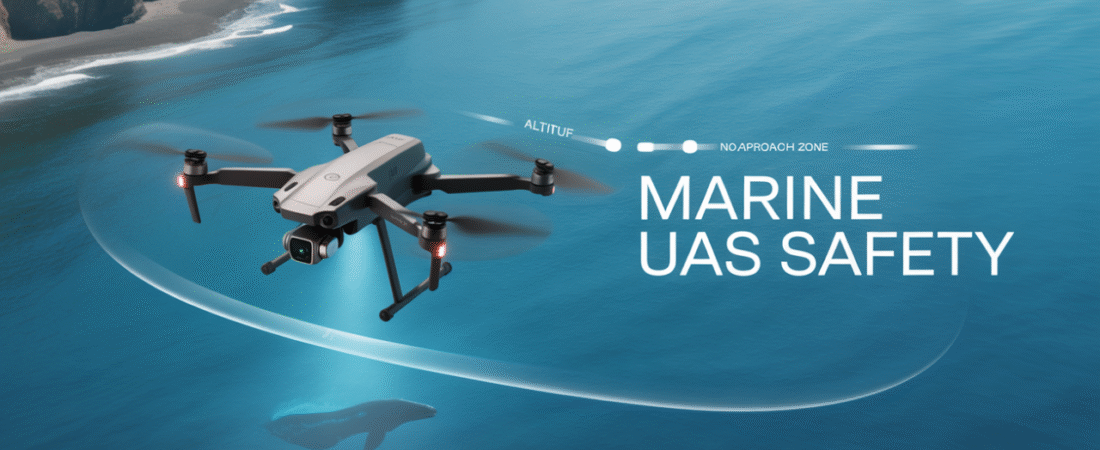
TL;DR
UAVs are becoming central to coastal enforcement and marine science, yet low-altitude surveillance flights can disturb sensitive species—especially marine mammals and seabirds—through acoustic masking and predator-like visual approach. Research shows that high-altitude scientific surveys cause little to no disturbance, while close-range regulatory missions often exceed harassment thresholds under U.S. law (MMPA/ESA), exposing operators to serious penalties. Sustainable integration requires adoption of scientific mitigation protocols, strict altitude management, lateral approaches, low-speed operation, high-zoom optics, real-time acoustic/behavioral monitoring, and specialized pilot training. Until NOAA finalizes national UAS guidance, agencies must proactively adopt these SOPs to balance enforcement goals with wildlife protection.
I. Executive Summary and Introduction to UAV Deployment in Maritime Governance
A. The Strategic Role of UAS in Coastal and Maritime Enforcement
Unmanned Aerial Systems (UAS), commonly referred to as drones, represent a transformative technology for maritime governance and conservation science. Their inherent ability to access remote or hazardous areas and collect high-resolution spatial data with significantly reduced human physical presence positions them as an invaluable tool for modern port security, ship emissions inspection, and fisheries enforcement.1 Research indicates that these platforms can offer a less disruptive alternative to traditional methods, such as manned aerial surveys or vessel-based ground surveys, which often elicit detectable adverse behavioral responses from wildlife.2
However, the proliferation of UAS technology, particularly in surveillance operations that often require low-altitude maneuvers, has introduced a new dimension of anthropogenic disturbance in marine and coastal environments.3 Studies have identified significant concerns regarding the potential for drones to negatively influence animal behavior, trigger acute physiological stress responses, and, in severe cases, cause temporary or chronic habitat displacement.4 The portrayal of drones as sources of disturbance in natural habitats has generated public apprehension, frequently fueled by media reports highlighting instances of wildlife harassment.4
B. Structure and Thesis of the Report
This analysis examines the bioacoustic and behavioral effects of Unmanned Aerial Vehicles (UAVs) on seabirds and marine mammals. It contrasts the disturbance potential of low-altitude regulatory surveillance operations against the success of ethical protocols developed in oceanographic research. The evidence demonstrates that the ecological impact of UAVs is critically dependent on operational parameters, including altitude, speed, and approach geometry. While scientific applications prove the potential for non-invasive monitoring at high survey altitudes, the need for close-range regulatory inspection often necessitates low-altitude maneuvers that cross biological disturbance thresholds. The conclusion of this report is that the institutionalization of science-based mitigation protocols and adherence to mandatory regulatory altitudes are essential for the sustainable integration of UAVs into maritime operations.
II. Biophysiological Mechanisms of Disturbance
The disturbance caused by UAVs on marine life operates through two primary pathways: acoustic stimulation and visual/proximal sensory stimulation, both of which can induce measurable physiological stress.
A. Acoustic Disturbance: The Airborne-to-Underwater Pathway
The noise generated by UAVs presents a unique challenge to marine life. Unlike large vessel traffic, which produces broadband, low-frequency sound, small- and medium-sized UAVs generate distinct tonal noise, with significant energy typically found at frequencies below 2 kHz.5
Conventional literature once suggested that small and medium UAVs generated minimal underwater noise, leading to the belief that they caused little disturbance to submerged marine fauna.3 However, the noise generated by the drone in flight introduces an atmospheric source of noise that couples with the water surface, creating potential adverse impacts when operating at low altitudes.3
Quantitative bioacoustic analyses indicate that while the median broadband received levels underwater are relatively low (often less than 100 dB re 1 $\mu \text{Pa}$ rms), these measurements vary significantly with drone altitude, flight mode, and recorder depth.5 The true ecological concern lies in the frequency overlap between drone noise and marine animal communication. Specific data reveal that the drone’s power spectral density can exceed ambient underwater noise levels by up to 30 dB in the crucial frequency band of 100 to 10,000 Hz.5
This significant exceedance over the background noise in a key frequency range is critical. This band encompasses the primary acoustic signals used by many odontocetes (toothed whales and dolphins) and pinnipeds (seals and sea lions) for communication, foraging, and echolocation.3 Consequently, the principal acoustic threat posed by low-altitude surveillance UAVs is not physical hearing trauma, but rather acoustic masking. This masking effect disrupts communication and echolocation signals, leading directly to modified vocalizations, avoidance behaviors, and disruption of critical life functions, which constitutes Level B Harassment under federal protection acts.3 Therefore, assessing the impact requires evaluation based on critical ratios and masking potential rather than solely on absolute source level.
B. Visual and Proximal Disturbance: The Predator Stimulus
The close physical proximity and flight path of a UAV can elicit strong behavioral responses due to perceived predation risk. The geometry of the flight path is a determinant factor in disturbance intensity. Studies have consistently found that a direct approach from above results in markedly higher behavioral responses, likely because animals cannot easily look directly overhead, leading them to interpret the unseen, noisy approach as a predatory maneuver.1 Lateral or oblique movement by the drone is preferable and mitigates this predatory mimicry effect.1
Certain operational behaviors common in close-range surveillance are explicitly identified as harassment risks. NOAA guidelines unequivocally state that buzzing, hovering, landing, taking off, and taxiing near marine mammals, whether they are on land or in the water, are activities highly likely to harass the animals and cause undue stress.7 Surveillance and inspection missions (e.g., fisheries enforcement or port infrastructure inspection) frequently require these exact maneuvers, creating an inherent conflict with protocols designed to minimize wildlife stress.
C. Physiological Markers of Stress
The presence of drones can trigger immediate physiological stress responses in wildlife, which subsequently alter animal behavior.1 This stress response is quantifiable by measuring stress hormones, such as cortisol and adrenaline, which are essential markers of an animal’s “stress load”.10 Chronic stress, resulting from repeated or prolonged exposure to stressors like drone noise and proximity, is a grave conservation concern, as it is linked to increased disease susceptibility, reduced reproductive output, and decreased overall survival rates in marine mammal populations.10
Researchers monitor stress markers across various matrices (blood, blubber, feces).10 A critical methodological consideration arises from the fact that the sample collection process itself—especially invasive methods involving chase or restraint—can artificially elevate stress hormone levels, masking the true signal caused by the drone exposure.11 This challenge reinforces the utility of UAVs in collecting non-invasive biological samples (e.g., blow or feces) and validates the importance of incorporating long-term physiological monitoring alongside behavioral observations to fully understand cumulative impacts.4
The technical characteristics of small-to-medium UAV noise pollution in marine environments underscore the risk posed by surveillance operations that operate at suboptimal altitudes or flight paths.
Table 3: Technical Acoustic Profile and Ecological Risk of Small-to-Medium UAVs
| Acoustic Metric | Environment | Quantified Range | Ecological Significance | Source |
| Broadband Source Level (Air) | Air | 77–89 dB re 20 $\mu \text{Pa}$ rms @ 1 m | High potential for airborne disturbance, leading to visual/behavioral response | 5 |
| Broadband Received Level (Underwater) | Water | < 100 dB re 1 $\mu \text{Pa}$ rms | Absolute levels generally low, but dependent on flight mode/depth/altitude | 5 |
| Exceedance Over Ambient Noise | Water | Up to 30 dB (100–10,000 Hz) | Critical risk of masking communication and echolocation signals (Level B Harassment) | 5 |
| Dominant Frequency Range | Air/Water | Distinct tones < 2 kHz | Low frequency components may penetrate water surface and be detected by mysticetes | 5 |
III. Analysis of Impact Thresholds: Surveillance vs. Scientific Research
The impact of UAVs is best understood by contrasting the outcomes of enforcement surveillance, which often requires close approach, with rigorously controlled scientific research, which prioritizes non-invasive data collection.
A. Evidence of Behavioral Disturbance in Surveillance Scenarios
In surveillance-type scenarios involving low-altitude operation, animals frequently exhibit adverse behavioral responses, including avoidance, increased vigilance, and flight responses.1 For instance, published studies have documented that beluga whales exhibit clear evasive responses when exposed to low-altitude drone flights, demonstrating a measurable disturbance effect.3 The sensitivity of marine animals, particularly cetaceans, is influenced by both the operational variables (altitude, speed, noise) and species-specific factors, such as the presence of groups or juveniles.1
For coastal seabirds, particularly those in high-density nesting areas, UAVs also pose risks. Surveys of Arctic cliff-nesting seabirds, such as the Glaucous gull, suggest that negative responses to UAVs can occur, potentially leading to errors or skewing of population census counts, thereby undermining the data collected.12
B. Scientific Case Studies: UAVs as a Less Invasive Tool
In contrast to the risks associated with general low-altitude surveillance, scientific application of UAVs, conducted under strict mitigation protocols, has proven highly successful in non-invasive monitoring.
One of the most extensive analyses of wildlife response to Unoccupied Aerial Systems involved three species of Antarctic predators: Antarctic fur seals, leopard seals, and chinstrap penguins.2 Despite the ecological differences among these species, the research found a consistent result: none of the species exhibited detectable behavioral reactions when the drones were flown at standard survey altitudes.2 This finding is particularly salient because the same populations did react to human researchers conducting traditional ground-based surveys, confirming that the animals were capable of detecting a threat, but that the UAV platform, when operated correctly, was not perceived as one.2
Furthermore, UAV technology has provided unprecedented ecological insights. For instance, UAS enabled researchers to document novel and nuanced gray whale foraging tactics (e.g., 58 headstands, 17 side-swimming events) and 33 unique social events (such as nursing and coordinated surfacings) that traditional boat-based observation methods had failed to identify.13 This underscores the significant added value of UAS technology when utilized under controlled, low-disturbance conditions.
The disparity between these two sets of findings reveals a central dilemma: the Altitude-Efficacy Conflict inherent in enforcement applications. Scientific studies achieve non-invasiveness through high-altitude, low-impact surveying. Conversely, regulatory surveillance (e.g., port or fisheries inspection) often requires low-altitude, close-range inspection to capture necessary detail, such as reading vessel names or inspecting net configuration. This requirement for close proximity directly contradicts the operational parameters necessary to remain below the biological disturbance threshold established by ethical scientific practice. Resolution of this conflict demands that enforcement mandates the use of specialized, high-resolution zoom technology to maintain operational efficacy without compromising biological safety altitudes.
IV. Regulatory Landscape and the Mandate to Prevent Harassment
A. Legal Definitions and Penalties under U.S. Law
Marine mammals, including all dolphins, whales, seals, and sea lions, are protected under the Marine Mammal Protection Act (MMPA) and, in the case of endangered species, the Endangered Species Act (ESA).8 Disturbing or harming these species is a violation of federal law.9
The MMPA defines harassment across two levels 6:
- Level A Harassment: Any act that has the potential to injure a marine mammal or marine mammal stock in the wild.6
- Level B Harassment: Acts that have the potential to disturb a marine mammal by disrupting key behavioral patterns, including but not limited to, migration, breathing, nursing, breeding, feeding, or sheltering.6
Low-altitude UAV surveillance operations that cause avoidance responses or physiological stress responses (as documented in belugas and other species) legally constitute Level B harassment.6 Violators of the MMPA face severe federal penalties, including civil fines up to $36,498, potential criminal fines, and up to one year in prison.6 The NOAA Fisheries Enforcement Hotline provides a mechanism for the public to report incidents of marine mammal harassment or violations.6
B. Current Mandated Approach Distances and Altitude Minimums
Federal guidelines establish minimum safe altitudes for aerial viewing of marine mammals, which, crucially, are often applied directly to UAV operations due to their potential for disturbance.7
Current guidelines generally require a minimum altitude of 1,000 feet when viewing marine mammals from the air.8 This standard is codified in federal law for specific species, such as humpback whales in Hawaii.7 For critically endangered species, the regulations are even stricter: aircraft and drones are legally required to maintain a 1,500-foot minimum altitude over North Atlantic right whales throughout U.S. waters.7
NOAA explicitly mandates that UAV operators avoid flying near marine animals and refrain from activities such as buzzing, hovering, landing, taking off, or taxiing near them, as these maneuvers are identified as stressors.8
Table 2: Summary of U.S. Regulatory and Scientific Minimum Approach Distance Guidelines for UAVs
| Species/Context | Regulatory Body/Source | Altitude Requirement (Minimum) | Horizontal Distance (Minimum) | Legal Status/Application |
| North Atlantic Right Whales | U.S. Federal Law (NOAA) | 1,500 feet | 500 yards (Vessel) | Mandatory (Applies to aircraft and drones) 7 |
| Humpback Whales (Hawaii/Alaska) | U.S. Federal Law (NOAA) | 1,000 feet | 100 yards (Vessel) | Mandatory [8] |
| Marine Mammals (General Viewing) | NOAA Fisheries | Avoid buzzing/hovering | Avoid flying near animals | General Guidance 8 |
| Deterrence (Permitted Research) | NMFS Guidelines | Altitude adjustments slow, away from animals | No closer than 5 m | Permitted Use Only 15 |
C. The Regulatory Gap: Developing National Guidance
Currently, NOAA Fisheries is developing comprehensive national guidance specifically for drone (UAS) operations targeting marine mammals and sea turtles.8 Until this guidance is finalized, the regulatory framework relies heavily on standards developed for manned aircraft and generalized “avoidance” principles.
This interim reliance creates a regulatory enforcement paradox. Surveillance drones are increasingly employed by enforcement agencies (such as NOAA Office of Law Enforcement and Coast Guard components) to monitor activities like illegal fishing or pollution—in essence, to enforce the MMPA.14 However, if these enforcement drones operate below the mandated 1,000 to 1,500-foot altitude minimums to achieve the inspection fidelity required for legal evidence, they risk committing Level B harassment themselves.6 The instrument of law enforcement thus risks violating the very statutes it is intended to protect. This tension highlights the urgent need for specialized, standardized operational guidance from NOAA that reconciles the need for effective surveillance with the non-negotiable legal mandates to prevent harassment.
V. Mitigation Protocols and Best Practices from Oceanographic Research
Scientific research, operating under rigorous permitting from regulatory bodies like NOAA Fisheries, has established effective Standard Operating Procedures (SOPs) for minimizing disturbance.8 These mitigation protocols are essential blueprints for any maritime surveillance application wishing to operate ethically and legally.
A. Optimized Flight Geometry and Approach Vector Control
To avoid triggering stress responses that mimic predation, the geometry of drone approach must be strictly managed. Direct overhead paths, which induce greater behavioral responses, are to be avoided entirely.1 Operators should utilize lateral or oblique flight paths as the preferred approach vector.1
Speed control is another crucial operational variable. Low speeds are effective in minimizing potential stress reactions, particularly when operating in the vicinity of vulnerable animals such as juveniles or group aggregations.1 Recommended flight speeds are maintained below 5 meters per second (approximately 18 km/h). Other studies have noted that maintaining specific low airspeeds, such as 20 to 25 km/h, allowed drones to pass by wildlife with negligible disturbance.1 Furthermore, any necessary altitude adjustments must be executed slowly and intentionally away from the targeted animals.15
B. Phased Approach and Behavioral Monitoring
Successful non-invasive monitoring requires starting observations at a demonstrably safe distance and utilizing a phased approach. Proximity at smaller distances is acceptable only if the animals are actively exhibiting neutral, non-reactive behaviors.1 This necessitates the presence of trained personnel capable of real-time ethological assessment during surveillance flights to ensure immediate protocol adjustment or mission abortion if distress indicators are observed.
To understand both short-term and cumulative effects, comprehensive monitoring programs are mandatory. These programs utilize technologies such as GPS collars, remote cameras, and biometric sensors to rigorously document wildlife responses (behavioral changes and physiological data, such as cortisol levels) before, during, and after repeated drone exposure.4 Such research provides the necessary data to establish sustainable practices and species-specific ethical guidelines for chronic exposure scenarios.
Table 1: Comparative Wildlife Response to UAV Operations by Operational Variable
| Species/Context | Operational Variable | Disturbance Effect | Mitigation Criterion | Source |
| Marine Mammals (General) | Low Altitude/Proximity | Avoidance, stress, communication disruption | High Altitude, Distance | [3, 9] |
| Belugas | Low Altitude Flight | Evasive responses | Strict Altitude Protocol | 3 |
| Antarctic Predators (Seals/Penguins) | Survey Altitude | No detectable reaction | Maintain High Survey Altitudes | 2 |
| Wildlife (General) | Direct Overhead Path | High behavioral response (Predator mimicry) | Lateral/Oblique Approach Only | 1 |
| Waterfowl/Wildlife | Flight Speed | Increased stress reactions | Speed < 5 m/s or 20–25 km/h | 1 |
C. Regulatory and Technological Requirements for Mitigation
For surveillance operations to be sustainable, mitigation must be integrated as a fundamental design constraint, not merely a post-flight adjustment. This requires specific technological and procedural mandates.
- Acoustic Modeling: Given the complexities of airborne sound transmission into the aquatic environment, especially in coastal zones, regulatory agencies must utilize appropriate sound propagation models, such as Parabolic Equation (PE) models.16 These sophisticated models are necessary to accurately predict and map the underwater noise footprint of UAVs, ensuring that flight paths avoid zones where the predicted sound level exceeds masking thresholds.
- Specialized Hardware Procurement: Agencies conducting maritime surveillance should prioritize the procurement of UAV platforms specifically engineered for extremely low acoustic signatures, particularly within the 100–10,000 Hz frequency band responsible for acoustic masking.5 Furthermore, platforms must be equipped with high-fidelity, high-zoom optics that eliminate the operational requirement for pilots to descend below established altitude minimums (1,000–1,500 feet) to gather necessary data for enforcement purposes.
- Permitting and Legal Compliance: All non-recreational drone use in protected marine areas, particularly if the operation risks encountering marine mammals or sea turtles, must secure the proper permits and authorizations, similar to the process required for scientific research.8 This establishes a clear legal distinction between permissible, regulated surveillance and unauthorized, high-risk operations. The specific mitigation protocols (low speed, oblique angle, phased approach) fundamentally transform the operational design, requiring pilots to deviate from standard speed and route-optimized commercial flight patterns.
VI. Comprehensive Recommendations for Ethical and Sustainable Maritime Surveillance
Based on the synthesis of bioacoustic data, behavioral science, and regulatory constraints, the following recommendations are presented for maritime and coastal regulatory bodies to ensure ethical and sustainable UAV integration into enforcement and surveillance operations.
A. Policy and Regulatory Mandates
- Accelerate and Finalize NOAA National Guidance: The development and immediate publication of the forthcoming national guidance for drone operations targeting protected marine species 8 must be expedited. This guidance must explicitly address the Altitude-Efficacy Conflict by providing clear, science-based protocols for surveillance operations requiring close-range data acquisition (e.g., vessel inspection) that mandate the use of high-resolution technology over low-altitude flight.
- Mandate Compliance with Scientific SOPs: All governmental, state, and sanctioned commercial surveillance operations must adopt the scientifically derived mitigation protocols (e.g., speed below 5 m/s, lateral approaches, phased introduction) as mandatory Standard Operating Procedures (SOPs), especially when operating below the 1,000-foot altitude threshold in non-critical habitat areas.
- Establish Clear Exclusion Zones: Define and enforce both permanent and temporary drone exclusion zones around biologically sensitive areas, such as critical breeding, nursing, and haul-out sites. These zones must be non-negotiable for all non-essential surveillance activities, mitigating the risk of cumulative or chronic stress on vulnerable populations.
B. Operational and Technological Recommendations
- Specialized Pilot Training and Certification: Implement a mandatory, specialized training and certification curriculum for all surveillance pilots focused on marine mammal ethology and low-impact flight mechanics. Training should emphasize recognition of subtle behavioral stress indicators and the disciplined use of oblique approaches and constant, slow velocity control.
- Prioritize Low-Acoustic Platforms and Advanced Optics: Regulatory agencies must actively acquire UAV platforms that minimize acoustic signatures, particularly in the 100–10,000 Hz masking frequency range, and possess high-magnification optical sensors. The technological capability must remove the operational necessity of breaching the federally mandated minimum altitudes.
- Integrate Real-Time Ecological Monitoring: Develop and deploy real-time acoustic monitoring systems (hydrophones) integrated with flight management software. This system should provide immediate warnings to the pilot when drone noise levels exceed predicted ambient noise thresholds, or when real-time visual monitoring detects behavioral stress indicators, mandating immediate cessation or increase in altitude. This ensures that the application of mitigation is data-driven and responsive to the biological state of the marine environment.
Works cited
- Impact of Drone Disturbances on Wildlife: A Review – MDPI, accessed November 5, 2025, https://www.mdpi.com/2504-446X/9/4/311
- Drones May Be The Answer To Less-Invasive Ecological Monitoring – NOAA Fisheries, accessed November 5, 2025, https://www.fisheries.noaa.gov/feature-story/drones-may-be-answer-less-invasive-ecological-monitoring
- Unveiling the Impact of Drone Noise on Wildlife: A Crucial Research Imperative – WUR eDepot, accessed November 5, 2025, https://edepot.wur.nl/670938
- Impact of Drone Disturbances on Wildlife: A Review – Preprints.org, accessed November 5, 2025, https://www.preprints.org/manuscript/202503.0892/v1
- Aerial and underwater sound of unmanned aerial vehicles (UAV) – Canadian Science Publishing, accessed November 5, 2025, https://cdnsciencepub.com/doi/10.1139/juvs-2016-0018
- Frequent Questions: Feeding or Harassing Marine Mammals in the Wild | NOAA Fisheries, accessed November 5, 2025, https://www.fisheries.noaa.gov/marine-life-distress/frequent-questions-feeding-or-harassing-marine-mammals-wild
- Guidelines and Distances for Viewing Marine Life | NOAA Fisheries, accessed November 5, 2025, https://www.fisheries.noaa.gov/topic/marine-life-viewing-guidelines/guidelines-and-distances
- Marine Life Viewing Guidelines – NOAA Fisheries, accessed November 5, 2025, https://www.fisheries.noaa.gov/topic/marine-life-viewing-guidelines
- Viewing Marine Life | NOAA Fisheries, accessed November 5, 2025, https://www.fisheries.noaa.gov/insight/viewing-marine-life
- Stress Physiology – National Marine Mammal Foundation, accessed November 5, 2025, https://nmmf.org/our-work/biologic-bioacoustic-research/stress-physiology/
- Effects of Stress on Marine Mammals Exposed to Sound – Office of Naval Research, accessed November 5, 2025, https://www.nre.navy.mil/media/document/final-workshop-proceedings-effects-stress-marine-mammals-exposed-sound-4-5-november
- Seabird species vary in behavioural response to drone census – PubMed, accessed November 5, 2025, https://pubmed.ncbi.nlm.nih.gov/29263372/
- Drone Up! Quantifying Whale Behavior From a New Perspective Improves Observational Capacity – Frontiers, accessed November 5, 2025, https://www.frontiersin.org/journals/marine-science/articles/10.3389/fmars.2018.00319/full
- Report A Violation | NOAA Fisheries, accessed November 5, 2025, https://www.fisheries.noaa.gov/national/enforcement/report-violation
- Guidelines for Safely Deterring Marine Mammals – Federal Register, accessed November 5, 2025, https://www.federalregister.gov/documents/2020/08/31/2020-18718/guidelines-for-safely-deterring-marine-mammals
- Underwater Sound Propagation Modeling in a Complex Shallow Water Environment – Frontiers, accessed November 5, 2025, https://www.frontiersin.org/journals/marine-science/articles/10.3389/fmars.2021.751327/full
- A Review and Meta-Analysis of Underwater Noise Radiated by Small (<25 m Length) Vessels – MDPI, accessed November 5, 2025, https://www.mdpi.com/2077-1312/9/8/827