
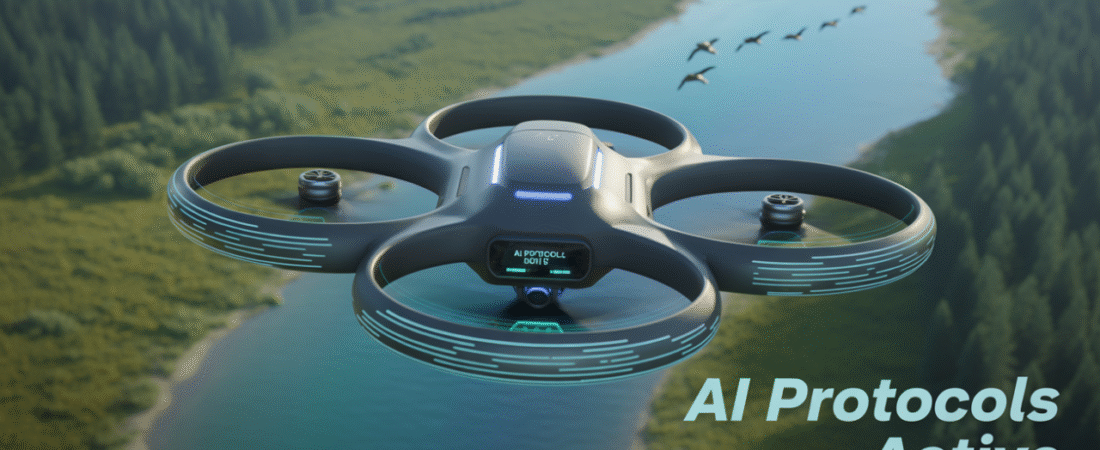
TL;DR — Executive Summary
This article outlines how Unmanned Aerial Vehicles can be redesigned to operate safely around wildlife by reducing their acoustic, visual, and thermal signatures; by adopting biomimetic flight behaviors; and by integrating swarm-based AI safety protocols. Key approaches include quiet propeller/motor design, active noise cancellation, adaptive camouflage, thermal load management, flapping- or morphing-wing designs, and predictive threat-avoidance behaviors. Autonomous wildlife-centric protocols — Pause/Hold, Coordinated Dispersal, and Abort/RTH — enable safe BVLOS conservation missions while meeting SORA/OSO regulatory expectations. The result is a next-generation framework where UAV performance, ecological ethics, and regulatory compliance reinforce each other to protect sensitive species and habitats.
1. Contextual Mandate and Innovation Roadmap
The increasing deployment of Unmanned Aerial Vehicles (UAVs) in conservation, ecological monitoring, and remote sensing necessitates a strategic pivot toward designs that guarantee ecological harmony. Traditional drone systems, optimized primarily for payload and endurance, frequently present unacceptable acoustic, visual, and thermal signatures that stress or displace sensitive fauna, particularly during critical periods such as breeding.1 This report analyzes the technical pathways required to achieve true wildlife safety, focusing on specialized physical stealth measures, bio-inspired flight dynamics, and robust, intelligent swarm control protocols designed to minimize detection and mitigate conflict. The objective is to move beyond conventional platform design into a specialized domain of multi-sensory stealth mitigation and proactive, wildlife-centric artificial intelligence (AI).
2. Physical Design Innovations for Reduced Detectability (Stealth)
Achieving ecological safety requires designers to reduce the UAV’s signature across the three primary sensory domains utilized by wildlife: acoustic, visual, and thermal.
2.1. Advanced Acoustic Stealth: Mitigating Noise Pollution
Acoustic noise constitutes a major source of stress for many wildlife species, often leading to avoidance behavior.1 Mitigation strategies must address both the passive physical generation of sound (aeroacoustics) and active computational suppression techniques.
2.1.1. Propeller Aeroacoustic Optimization and Component Selection
The principal noise source in rotary UAVs originates from the propulsion system, encompassing the motor, the Electronic Speed Controller (ESC), and the propeller blades.2 Extensive academic research focuses on benchmarking thrust versus acoustic output under controlled testing conditions. Experimental platforms typically integrate components such as an HRB 6000 mAh 3 S Lithium Polymer (LiPo) Battery for power supply, a 30 Ampere Brushless Motor Electric Speed Controller for power regulation, and high-fidelity sensors (e.g., the Racerstar Motor Thrust Stand V3) to accurately measure performance.2
Optimizing propeller geometry based on established principles of aeroacoustics, particularly those pertaining to low Mach number flows, is crucial for passive noise reduction at the source.2 This involves minimizing the dynamic pressure fluctuations that generate sound. However, propulsion component selection introduces a fundamental design constraint: reducing noise output typically necessitates slower propeller tip speeds and, consequently, larger diameter propellers to maintain the requisite thrust. The selection of components, such as a Readytosky 2212 920KV Brushless Motor, must be governed by optimizing specific thrust (thrust per watt) at the lowest viable rotational velocity. Designers must ensure that the demand for low noise (slower tip speeds) does not significantly increase platform mass and drag, which would compromise the overall efficiency profile of the aircraft.3 Optimal design, therefore, requires sophisticated motor control integrated with tailored propeller geometry to balance thrust requirements against acoustic stealth.
2.1.2. Active Noise Suppression Technologies (ANSC)
Beyond passive design, computational methods offer a dynamic solution to managing noise output tailored to the operational conditions. Research proposes the use of Generative Adversarial Networks (GANs) to generate an inverse sound signal that actively cancels the noise produced by the drone.4 This training data must be comprehensive, spanning the full acoustic diversity of drone operation, including steady-state propeller tones, rapid throttle transitions (mimicking ascent or descent), and superimposed broadband turbulence.4 This AI-driven approach is invaluable because propeller noise is highly variable and depends entirely on the operational phase, rendering static passive solutions ineffective during dynamic maneuvers.4
The implementation of Active Noise Cancellation (ANC) systems, however, imposes a system constraint related to the energy budget. ANC requires dedicated onboard hardware, including microphones, substantial processing power for the GAN model, and powerful actuators or speakers to generate the counter-phase signal. This processing demands a significant amount of energy, inevitably reducing the overall flight endurance of the UAV.5 In conservation missions, where maximizing range and time aloft is essential for cost-effectiveness 6, this power requirement diminishes the operational return on investment (ROI) usually derived from labor and time savings.8 Therefore, the technical assessment must quantify whether the resulting guaranteed reduction in wildlife disturbance, leading to superior data collection and regulatory compliance, strategically outweighs the operational cost of shorter missions and reduced battery life.
2.2. Visual Stealth: Materials and Shape Optimization
The ability of wildlife to detect a UAV depends heavily on their recognition of motion, edges, and overall shape, not merely color.9 A multi-faceted approach to visual stealth is thus mandatory.
2.2.1. Camouflage Based on Visual Perception Models
Effective concealment requires disrupting the unambiguous encoding of discontinuities in intensity (edges) and minimizing other key visual attributes, particularly motion.9 If an object is detected, the objective is to induce hesitation in the animal, forcing it to pause and evaluate the object instead of immediately fleeing.10 For UAV platforms, this technique utilizes neutral tones (earthy browns, greens, and grays) that naturally mimic the background environment.10 Furthermore, the application of low-reflective fabrics or surface coatings is necessary to minimize the reflective glare that can catch the eye of vigilant fauna.10
It is important to recognize that basing camouflage solely on human visual acuity, often simulated by standard Red-Green-Blue (RGB) sensors, is insufficient, as these sensors may struggle to detect cryptic species in heterogeneous landscapes.11 Wildlife visual systems often operate across different spectral ranges or include sensitivities (e.g., ultraviolet) not captured by human vision models. Therefore, achieving true visual concealment requires materials that dynamically or statically match the background across the relevant spectral bandwidths of the target species (e.g., avian or mammalian vision), moving beyond a simple static application of colored paint.
2.2.2. Threat Perception Mitigation (Shape and Movement)
The drone’s physical form and, critically, its flight kinetics dictate whether it is perceived as a threat or a benign presence. Behavioral mitigation strategies are essential; drones must avoid direct approach trajectories toward animals, and their design should attempt to mimic non-threatening birds rather than known predators.1 Large predatory birds, such as eagles, are known to attack drones, resulting in injury to the bird and costly damage to the equipment.1
Consequently, launch and recovery operations—the most visible and potentially threatening phases of the mission—must be conducted far away from animals and preferably out of sight.1 The operational safety signature of a UAV is defined by its trajectory and handling just as much as its physical design. R&D must involve modeling threat responses based on movement patterns, actively avoiding sporadic, sudden, or threatening movements. Optimal wildlife-safe design is a holistic endeavor, co-optimizing acoustic and visual stealth with mandatory software protocols governing flight kinematics to ensure perceived ecological harmony.
2.3. Thermal Stealth: Signature Reduction and Management
As conservation and monitoring missions increasingly occur during nocturnal or low-light hours, reducing the thermal signature becomes critical to evade detection, both by thermal imaging equipment used by human observers and by nocturnal fauna with high thermal acuity.11 High-density electronic components are known to generate substantial waste heat, necessitating sophisticated thermal management.
2.3.1. Advanced Thermal Management Systems (TMS)
Advanced TMSs are essential for modern powertrains due to the expected increase in waste heat generated by large electric components.3 Conventional cooling methods include passive approaches like heat sinks, leveraging rotor downdrafts, or using forced-air cooling.5 However, low thermal visibility often requires more robust, high-performance solutions.
Drawing from high-reliability aerospace applications, systems such as those developed for NASA’s Volatiles Investigating Polar Exploration Rover (VIPER) mission offer critical design principles.14 That system utilizes Loop Heat Pipes (LHPs) and radiators to efficiently transport and reject excess heat, ensuring component longevity.14 Specific features, such as passive thermal control valves within the LHPs, allow for precise heat management by selectively regulating heat rejection.14 For UAV use, this advanced engineering capability can be utilized to minimize the thermal differential between the UAV surface and the ambient environment.
A critical design consideration is the Mass, Power, and Longevity Trilemma. Implementing robust TMS, such as LHPs, adds mass and complexity.5 This mass increase compromises battery life and flight endurance.5 Furthermore, the TMS itself requires power to operate auxiliary components, potentially driving up the waste heat it is intended to mitigate. Research must focus on micro-LHP or vapor chamber technologies optimized for minimal mass, prioritizing the removal of waste heat only to the extent required to match ambient temperature, rather than simply maximizing cooling capacity.
2.3.2. Thermal Insulation and Surface Treatment
Insulation plays a crucial role in passively isolating internal heat sources. High-performance insulation materials, such as aerogels or polystyrene, are effective in reducing the conductive thermal load and minimizing the energy required for active cooling systems.5
The efficacy of thermal stealth is strongly tied to ambient environmental conditions. Thermal infrared sensors generally exhibit poor performance in detecting animals during mid-afternoon surveys when solar gain elevates background temperatures.11 Conversely, during twilight or nocturnal operations, the thermal contrast is maximized, making the drone’s heat highly conspicuous.13 Therefore, the robustness of the thermal shielding system must be dynamically scaled based on the target mission profile, with maximum thermal integrity required for operations during cold or nighttime conditions where thermal visibility is paramount. Integrating insulation with active feedback control systems allows for the dynamic regulation of power based on real-time temperature readings, optimizing thermal performance while conserving battery power.5
3. Bio-Inspired Flight Dynamics and Ecological Harmony
Mimicking the flight mechanics of insects and birds offers intrinsic benefits that directly contribute to ecological harmony, including enhanced maneuverability, greater efficiency, and a significantly reduced acoustic signature compared to conventional propeller-driven platforms.6
3.1. Principles of Biomimicry and Performance Gains
Bio-inspired drone design draws deeply from the natural world, focusing on optimizing aerodynamics (wing shapes), propulsion (flapping wings or undulating fins), and sensing (replicating compound eyes or echolocation).6
One of the most significant advantages of biomimicry is the potential for improved energy efficiency, as nature has optimized flight for energy conservation.6 This improved energy efficiency, often realized through optimized lift and drag profiles, translates directly into increased flight time and operational range. This extended operational window yields a crucial environmental benefit: it reduces the number of launch and recovery cycles required to complete a given conservation task.6 Since launch and recovery are typically the most intrusive phases of drone operation near wildlife 1, increased endurance directly minimizes interaction frequency and overall environmental disruption. Thus, bio-inspired efficiency is inherently a measurable factor in wildlife safety and mission sustainability.
3.2. Flapping-Wing and Morphing-Wing Platforms
Flapping-wing drones (ornithopters) generate thrust and lift by mimicking the wings of birds or insects, offering a distinct departure from high-RPM rotors and a potentially lower acoustic footprint.6 Furthermore, designs inspired by birds that dynamically change their wing shape in flight introduce the concept of morphing wings, allowing drones to adapt their geometry to optimize performance across different flight regimes.6
For example, sophisticated systems like the RoboFalcon 2.0 demonstrate the technical maturity to mimic complex avian mechanics, including the powerful ventral-anterior downstrokes used for liftoff and the tucking of wings on the upstroke to reduce drag.15 The ability to adjust the wing sweep and fold mid-flight allows for fine pitch and roll control, contributing to overall flight stability, particularly during maneuvers like takeoff.15
However, the adoption of large, flapping-wing platforms mimicking birds of prey necessitates careful consideration of threat perception. While excellent performance is achieved by mimicking falcons, the design carries an intrinsic risk of being perceived as a threat or predator by smaller fauna, potentially inducing stress or antagonistic behavior.1 The R&D process must, therefore, integrate movement protocols that deliberately counter typical predatory kinematics, focusing instead on flight patterns deemed non-threatening to fulfill the ecological harmony mandate.1
4. Swarm Intelligence and Autonomous Wildlife Avoidance Protocols
The utilization of swarm robotics, where multiple agents coordinate to solve problems more efficiently than a single platform, is directly inspired by self-organizing systems such as bird flocks and fish schools.16 For conservation, integrating real-time wildlife detection with autonomous, decentralized decision-making is necessary to ensure collective safety and compliance.17
4.1. Fundamentals of Swarm Robotics for Environmental Applications
Swarm systems are differentiated from simple multi-agent systems by requiring at least three agents that share relative information (position, velocity, altitude) and adhere to a common set of interaction rules.16 This collective behavior provides advantages in area exploration, coverage, and real-time monitoring.16 For large-scale ecological surveys, swarms represent a powerful tool for rapidly collecting and processing vast amounts of data.17
4.2. Integrating Wildlife-Centric AI Protocols
Wildlife detection necessitates immediate and assured responses integrated directly into the swarm’s decision-making algorithms, translating faunal presence into dynamic navigational constraints.
4.2.1. The Immediate Pause and Hold Protocol
When onboard sensors (visual, thermal, or acoustic) detect fauna within a minimum safety perimeter, the protocol mandates that the closest agents immediately transition to an unresponsive, low-power hover state.12 This requires a reliable, decentralized state machine transition triggered by the proximity alert. This protocol directly adheres to conservation guidelines set by organizations like the WWF, which require minimizing wildlife disturbance and avoiding negative approach trajectories.1
4.2.2. Coordinated Dispersal Algorithms
If a group of fauna is detected directly on the flight path or within the operational volume, the swarm must execute a collective maneuver to bypass the zone without causing stress. Current research utilizes algorithms based on 3D curved obstacle tracking, often employing extensions of virtual force models or Particle Swarm Optimization (PSO) algorithms.18 Wildlife presence is treated computationally as a high-repulsion force field, prompting a smooth, collective divergence of the swarm around the conflict zone.18 Coordinated dispersal is critical, as non-coordinated avoidance could lead to erratic or sporadic movements that trigger a flight response from wildlife.1
4.2.3. The Abort/Return-to-Home Protocol for Sensitive Areas
Ethical and regulatory standards mandate strict avoidance of known nesting colonies, reproductive seasons, and sensitive territorial spaces.1 The most stringent protocol involves automatically aborting the mission if sensitive, pre-designated zones are identified during operation. All agents must then execute a collective Return-to-Home (RTH) procedure via designated, passive safety corridors.19 This highly robust function serves as a crucial tactical mitigation for Air Risk Class (ARC) management within regulatory frameworks like the Specific Operations Risk Assessment (SORA).20
4.3. Challenges in Real-World Swarm Deployment for Conservation
The successful transition of swarm technology from theory to reliable, industrial-grade applications remains a challenge.22 A key difficulty lies in the hard-to-predict nature of emergent behavior resulting from local interactions within a decentralized swarm.22 Many current projects still rely heavily on centralized control, circumventing the core concept of distributed decision-making.22
Regulatory frameworks, particularly those governing high-risk operations, demand high levels of assurance and predictability, outlined by the Safety Assurance and Integrity Level (SAIL) and Operational Safety Objectives (OSOs) within SORA.20 Purely decentralized, emergent behavior is intrinsically difficult to verify and assure. Therefore, conservation-critical swarms must adopt a hybrid control structure. Local (distributed) functions, such as immediate obstacle tracking, may be delegated to individual agents, but high-level safety commands—such as Dispersal, Abort, and RTH—must be enforced by a highly reliable, centralized Mission Manager. This modification ensures that the system maintains verifiable predictability required to satisfy regulatory and ethical robustness standards for high-risk environmental operations.
The following table summarizes the performance characteristics required for ecologically safe UAV platforms.
Table 1: Comparative Analysis of Stealth Technologies for Wildlife UAV Platforms
| Detection Modality | Conventional Rotary UAV | Bio-Inspired Flapping-Wing UAV | Advanced Stealth UAV (Proposed) | Key Research Focus |
| Acoustic Signature | High (Propeller Tones, Broadband Turbulence) 2 | Moderate (Lower inherent noise, shifting acoustic profile) 6 | Ultra-Low (Active Noise Cancellation integration) | Balancing power cost of GAN-based noise suppression against dynamic flight endurance 5 |
| Visual Signature | High (Conspicuous shape, movement, reflection) | Low (Mimics non-threatening fauna, variable wing geometry) 1 | Very Low (Adaptive Camouflage, edge/motion disruption coatings) 9 | Developing multispectral coatings adaptable across different faunal visual ranges 11 |
| Thermal Signature | High (Exposed motors/battery) 5 | Moderate (Lower power draw, reduced waste heat) 6 | Minimal (Integrated Loop Heat Pipes (LHP) and Aerogel insulation) 5 | Managing mass/power trade-offs to achieve dynamic surface temperature matching to ambient conditions [3, 11] |
| Movement Pattern | Sporadic, linear, predictable (high threat potential) | Natural, fluid, efficient (optimized pitch/roll control) 15 | Pre-programmed non-threatening trajectories, avoidance of direct approaches 1 | Kinematic modeling to confirm flight patterns do not trigger predatory response |
5. Regulatory, Ethical, and Implementation Frameworks
Technical innovation must be supported by robust operational and legal compliance frameworks to ensure successful deployment in sensitive ecosystems.
5.1. Conservation Guidelines and Ethical Operation
Conservation guidelines emphasize adherence to the precautionary principle and strict ethical processes.12 This includes being acutely aware of the species in the operational area, particularly endangered animals, and adjusting mission timing to avoid times when they are most active (e.g., nocturnal, twilight, or breeding seasons).1 Flight plans must be designed to route away from known nesting sites, burrows, or established territories.1 Launch and recovery sites must be intentionally located away from animals and kept out of sight to minimize acoustic and visual shock.1
Beyond direct disturbance, operations must account for the secondary environmental risk posed by the platform itself. Accidents involving drones can lead to pollution or wildfires in sensitive areas due to the presence of toxic and flammable components.23 Therefore, the safety mandate encompasses not just flight behavior and stealth performance but also the materials safety and structural integrity of the UAV hardware.
5.2. Regulatory Compliance for Advanced Operations (BVLOS/SORA)
High-efficiency, large-scale conservation missions frequently require Beyond Visual Line of Sight (BVLOS) capabilities, mandating compliance with rigorous international risk frameworks. In European jurisdictions, BVLOS falls under the EASA “Specific” category and requires operational authorization, typically achieved through the Specific Operations Risk Assessment (SORA), developed by the Joint Authorities for Rulemaking on Unmanned Systems (JARUS).19
SORA requires operators to meet 24 Operational Safety Objectives (OSOs), which are assigned a robustness level (Low, Medium, or High) based on the calculated risk profile (SAIL).20 The OSOs explicitly cover categories such as “Adverse Environmental Conditions” 21, which include meteorological factors and external elements that interfere with system performance.24 The presence of wildlife and the requirement for immediate, reliable avoidance protocols must be formalized and integrated as a high-robustness tactical mitigation strategy within the SORA safety case.21
This means the AI-driven wildlife protocols (Pause, Dispersal, Abort, RTH) are not merely desirable ethical additions, but necessary, measurable technical specifications required to gain authorization for complex BVLOS operations over ecologically sensitive or protected zones.19 Technical compliance with these high-integrity levels provides auditable proof of due diligence against environmental harm.
5.3. Economic Viability and Risk Management
The development and integration of advanced stealth and autonomous AI capabilities represents a substantial investment. Justifying this expenditure requires a rigorous Cost-Benefit Analysis (CBA) that extends beyond traditional metrics. Standard ROI calculations compare initial costs against gains in labor and time savings, enhanced safety for human personnel, and data precision.7 However, advanced wildlife-safe designs must incorporate the avoidance of externalized costs.
The quantifiable value derived from advanced stealth includes superior data quality (minimizing survey interruption and stress-induced behavioral bias) and, most importantly, the prevention of fines, regulatory actions, or costs associated with mission failure or wildlife injury.8
Furthermore, technical compliance acts as a form of risk reduction. Drones demonstrably featuring ultra-low acoustic profiles and non-threatening movements are less likely to encounter antagonistic interactions, such as attacks by eagles 1, or to cause accidents that result in damage to property or environmental harm.23 This reduction in operational risk should influence the financial structuring of the enterprise. A system with verifiable, high-integrity safety protocols provides quantifiable evidence of reduced exposure, which should translate into more favorable premiums for specialized Hull (physical damage) and Liability insurance.27 Advanced compliance thus transforms the investment in safety technology into a strategic mechanism for maximizing long-term ROI and stabilizing operational budgets.
The following table details the necessary AI protocols to manage conflict and environmental avoidance.
Table 2: Proposed Swarm AI Wildlife Conflict Avoidance Protocols
| Protocol Name | Trigger Condition | Swarm Behavior (Output) | Core AI Algorithm Required | Regulatory/Ethical Context |
| Immediate Pause and Hold | Fauna detected within minimum safety distance (e.g., 20m) 12 | Transition to low-power, fixed-position hover; immediate throttle modulation to minimize acoustic output 1 | Decentralized state machine transition guided by onboard sensor input. | Adherence to “Minimizing Disturbance” (WWF) and ethical flying principles.12 |
| Coordinated Dispersal | Fauna detected on predetermined flight path (dynamic avoidance required) | Swarm rapidly expands and divides using optimized curved tracking to avoid conflict zone 18 | Distributed virtual force model or Particle Swarm Optimization (PSO) with centralized override for boundary limits. | Compliance with JARUS SORA OSOs for Adverse Environmental Conditions.[21, 24] |
| Abort Mission/Return-to-Home | Fauna detected near high-sensitivity areas (e.g., nesting colonies, breeding grounds) 1 | Collective, automated return to launch site via pre-cleared, passive corridor. | Centralized Mission Manager oversight with high-robustness communication architecture.22 | Avoidance of breeding/reproductive seasons and territorial spaces.1 |
6. Conclusion and Strategic Recommendations
6.1. Synthesis of Stealth, Biomimicry, and AI Integration
Ecologically safe drone operations require a synthesis of physical, biological, and computational engineering efforts. A fundamental principle is that wildlife safety must be treated as a multi-sensory stealth requirement; compromising any single signature (acoustic, thermal, or visual) risks compromising the entire mission’s integrity.
Bio-inspired design contributes significantly to both stealth and operational longevity. The focus on energy conservation and aerodynamic efficiency observed in nature 6 translates directly into increased flight time, which in turn reduces the frequency of highly disruptive launch and recovery cycles.1 This establishes a causal relationship where improved engineering performance yields direct, positive ecological outcomes.
In the realm of autonomous control, achieving regulatory acceptance necessitates that designers prioritize predictable, high-robustness safety protocols over purely decentralized, emergent swarm behaviors.22 While natural systems inspire efficient collective movement, the safety-critical nature of conservation missions, governed by frameworks like SORA, demands a hybrid control system where centralized safety overrides guarantee verifiable compliance and mission assurance.21
6.2. Prioritized R&D Roadmap for Ecologically Safe UAVs
Based on the technical analysis and regulatory requirements, the following R&D roadmap is recommended:
- Phase I: Signature Reduction (Acoustic and Thermal)
- Initiate comprehensive mass-power trade-off modeling for the integration of Thermal Management Systems (TMS). The focus must be on micro-LHP technology and lightweight, high-performance insulation (e.g., aerogels) to ensure component stability while dynamically matching the external thermal signature to the ambient environment.5
- Develop and benchmark the performance of a Generative Adversarial Network-based Active Noise Suppression System (ANSC), specifically validating its real-time efficacy and energy cost during rapid throttle transitions and high-turbulence flight.5
- Phase II: Behavioral and Bio-Kinematic Integration
- Research and procure materials for adaptive, multispectral camouflage coatings. These materials must be tested against known avian and mammalian visual acuity models to ensure the disruption of edges and motion cues across relevant spectral ranges, not solely based on RGB visibility.9
- Model and validate flight control algorithms to ensure kinematic profiles adhere to non-threatening movement patterns, derived from bio-inspired mechanisms, rigorously avoiding trajectories that mimic predatory behavior.1
- Phase III: Swarm AI and Regulatory Compliance
- Construct a Hardware-in-the-Loop (HIL) simulation environment to quantitatively validate the robustness and reliability of the three core wildlife protocols (Pause and Hold, Coordinated Dispersal, Abort/RTH).18
- Formalize the developed AI protocols as High Robustness tactical mitigation strategies within the JARUS SORA framework documentation. This procedural step is critical for obtaining necessary National Aviation Authority (NAA) authorization for BVLOS operations over protected or sensitive ecological areas.19
- Phase IV: Economic and Ethical Validation
- Conduct a full Cost-Benefit Analysis (CBA) to quantify the economic value derived from stealth and AI, specifically modeling the reduction in financial risk associated with hull loss, operational downtime, and potential regulatory fines. This analysis will position investment in advanced safety features as a reduction in long-term risk premium.8
- Establish formal review protocols with leading conservation organizations to ensure that flight scheduling, species monitoring, and site selection rigorously adhere to the highest ethical and environmental standards, particularly regarding reproductive cycles and territorial spaces.1
Works cited
- Drones and Animal Welfare, accessed November 5, 2025, https://intranet.ecu.edu.au/__data/assets/pdf_file/0005/992102/drones-and-animal-welfare.pdf
- Towards silent and efficient flight by combining bioinspired owl feather serrations with cicada wing geometry – NIH, accessed November 5, 2025, https://pmc.ncbi.nlm.nih.gov/articles/PMC11109230/
- Design of Thermal Management Systems for Future Aircraft – mediaTUM, accessed November 5, 2025, https://mediatum.ub.tum.de/doc/1687068/document.pdf
- Silent Drones: A Deep Learning Approach to Suppress Drone Propeller Noise, accessed November 5, 2025, https://www.researchgate.net/publication/392137447_Silent_Drones_A_Deep_Learning_Approach_to_Suppress_Drone_Propeller_Noise
- Thermal Management for Unmanned Aerial Vehicle Payloads: Mechanisms, Systems, and Applications – MDPI, accessed November 5, 2025, https://www.mdpi.com/2504-446X/9/5/350
- Bio-Inspired Drones → Term – Prism → Sustainability Directory, accessed November 5, 2025, https://prism.sustainability-directory.com/term/bio-inspired-drones/
- Cost-Benefit Analysis: Investing in Disaster Drones – SafeSight Exploration, accessed November 5, 2025, https://safesightxp.com/2025/01/07/cost-benefit-analysis-investing-in-disaster-drones/
- The Cost-Benefit Analysis of Implementing Drones in Your Business, accessed November 5, 2025, https://peopledevelopmentmagazine.com/2024/08/23/implementing-drones/
- Camouflage and visual perception – PMC – PubMed Central – NIH, accessed November 5, 2025, https://pmc.ncbi.nlm.nih.gov/articles/PMC2674079/
- The Art and Science of Camouflage in Wildlife Photography, Hide and Seek in the Natural World, accessed November 5, 2025, https://wildlifephotoapprentice.com/2024/02/02/the-art-and-science-of-camouflage-in-wildlife-photography-hide-and-seek-in-the-natural-world/
- Supplementing aerial drone surveys with biotelemetry data validates wildlife detection probabilities – Frontiers, accessed November 5, 2025, https://www.frontiersin.org/journals/conservation-science/articles/10.3389/fcosc.2023.1203736/full
- WWF outlines drone guidelines for conservation – The Wildlife Society, accessed November 5, 2025, https://wildlife.org/wwf-outlines-drone-guidelines-for-conservation/
- Drones in ecology: ten years back and forth | BioScience – Oxford Academic, accessed November 5, 2025, https://academic.oup.com/bioscience/article/75/8/664/8169113
- ACT Delivers Critical Thermal Management System for NASA VIPER Mission, accessed November 5, 2025, https://www.1-act.com/about/news/act-delivers-critical-thermal-management-system-for-nasa-viper-mission/
- The Dawn of Bird-Like Flight – Impact Lab, accessed November 5, 2025, https://www.impactlab.com/2025/09/20/the-dawn-of-bird-like-flight/
- A Review of Swarm Robotics in a NutShell – MDPI, accessed November 5, 2025, https://www.mdpi.com/2504-446X/7/4/269
- Drones and AI-Driven Solutions for Wildlife Monitoring – MDPI, accessed November 5, 2025, https://www.mdpi.com/2504-446X/9/7/455
- Multitarget Search Algorithm Using Swarm Robots in an Unknown 3D Mountain Environment – MDPI, accessed November 5, 2025, https://www.mdpi.com/2076-3417/13/3/1969
- BVLOS Drones: Complete Guide to Beyond Visual Line of Sight – JOUAV, accessed November 5, 2025, https://www.jouav.com/blog/bvlos-drone.html
- What Are SORA’s OSOs? 24 Operational Safety Objectives for UAS Operations – SMS Pro, accessed November 5, 2025, https://aviationsafetyblog.asms-pro.com/blog/what-are-soras-osos-24-operational-safety-objectives-for-uas-operations
- JARUS guidelines on Specific Operations Risk Assessment (SORA) Executive Summary, accessed November 5, 2025, http://jarus-rpas.org/wp-content/uploads/2023/07/jar_doc_06_jjarus_sora_executive_summary.pdf
- Swarm Robotic Behaviors and Current Applications – Frontiers, accessed November 5, 2025, https://www.frontiersin.org/journals/robotics-and-ai/articles/10.3389/frobt.2020.00036/full
- Drones for Conservation in Protected Areas: Present and Future – MDPI, accessed November 5, 2025, https://www.mdpi.com/2504-446X/3/1/10
- JARUS guidelines on SORA Annex E Integrity and assurance levels for the Operational Safety Objectives (OSO), accessed November 5, 2025, http://jarus-rpas.org/wp-content/uploads/2024/06/SORA-v2.5-Annex-E-Release.JAR_doc_28pdf.pdf
- Part 108 Explained: The FAA’s New Drone Regulations – Pilot Institute, accessed November 5, 2025, https://pilotinstitute.com/part-108-explained/
- Evaluate ROI From Drone Inspections For Cost Measure, accessed November 5, 2025, https://skydronesolutions.com/evaluate-roi-from-drone-inspections-for-cost-measure/
- Drones and Insurance – Clyde & Co, accessed November 5, 2025, https://www.clydeco.com/en/insights/2022/03/drones-and-insurance
- Drone Insurance Guide 2025: Costs, Coverage & Best Providers – JOUAV, accessed November 5, 2025, https://www.jouav.com/blog/drone-insurance.html